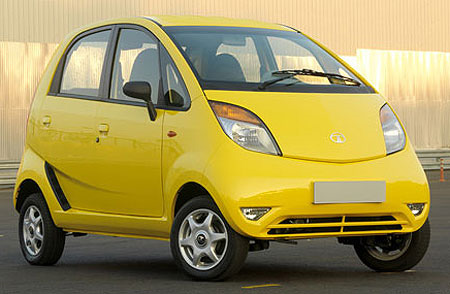
The Tata Nano is a fascinating vehicle. Launched in March 2009, it is the world’s cheapest car, retailing for $2,160 (production costs are said to be under $2,000). The car also seats four and gets 52 mpg city/61 mpg highway fuel economy courtesy of a Bosch 2-cylinder, 624 cc gasoline engine. The vehicle certainly has its downsides — lack of safety features and potential environmental impact — but it also promises radical societal change, bringing affordable transportation to the developing world.
Now Tata’s partner, the Robert Bosch Automotive Group, is looking to improve the Tata less than a year after its introduction. Its planning an engine variant for the Tata with a single diesel cylinder.
The engine size would be in the same ballpark as the gas engine — 550-650 cc displacement. Horsepower would drop to about 25-30 hp, versus 35 hp in the current nano. However, the already impressive fuel economy would likely get a nice boost.
The new diesel will likely be the world’s smallest automotive diesel engine — smaller even than the 800 cc three cylinder in the Smart Fortwo CDi.
The new engine work was announced by Bosch’s common-rail injection Bosch Chairman Dr. Bernd Bohr. Bosch, which invested $4.3B USD globally in research and development, is now very interested in stepping up its India operations after revenue from India grew 5 percent last year. In contrast, global revenues for the recession-stricken company dropped 15 percent.
Related Posts
Tesla Model 3 got outsold by an EV from a Chinese smartphone brand

The Chinese smartphone maker delivered 258,164 units of its first EV. Meanwhile, Tesla sold only 200,361 Model 3s, marking the first time since Tesla's Chinese launch that another brand has overtaken it in the world's largest EV market.
Your future BMW electric M3 will still sound like a real M car

Instead of trying to invent a new "sound of the future" filled with abstract spaceship hums and digital warbles, BMW’s Motorsport division is digging into its own history books. New videos from the development team reveal that the upcoming electric M3 will feature a synthetic audio system built from high-fidelity recordings of the brand’s most iconic internal combustion engines. We aren't talking about generic engine noises here; BMW is literally sampling the legends.
This is the tech that makes Volvo’s latest EV a major step forward

The 2027 Volvo EX60 boasts engineering improvements in a package that’s likely to have mass appeal. It’s based on a new architecture that offers improved range and charging performance, backed by software with now-obligatory AI integration. And as a five-seat SUV similar in size to the current Volvo XC60 — the automaker’s bestselling model — it’s exactly the type of car most people are looking for.