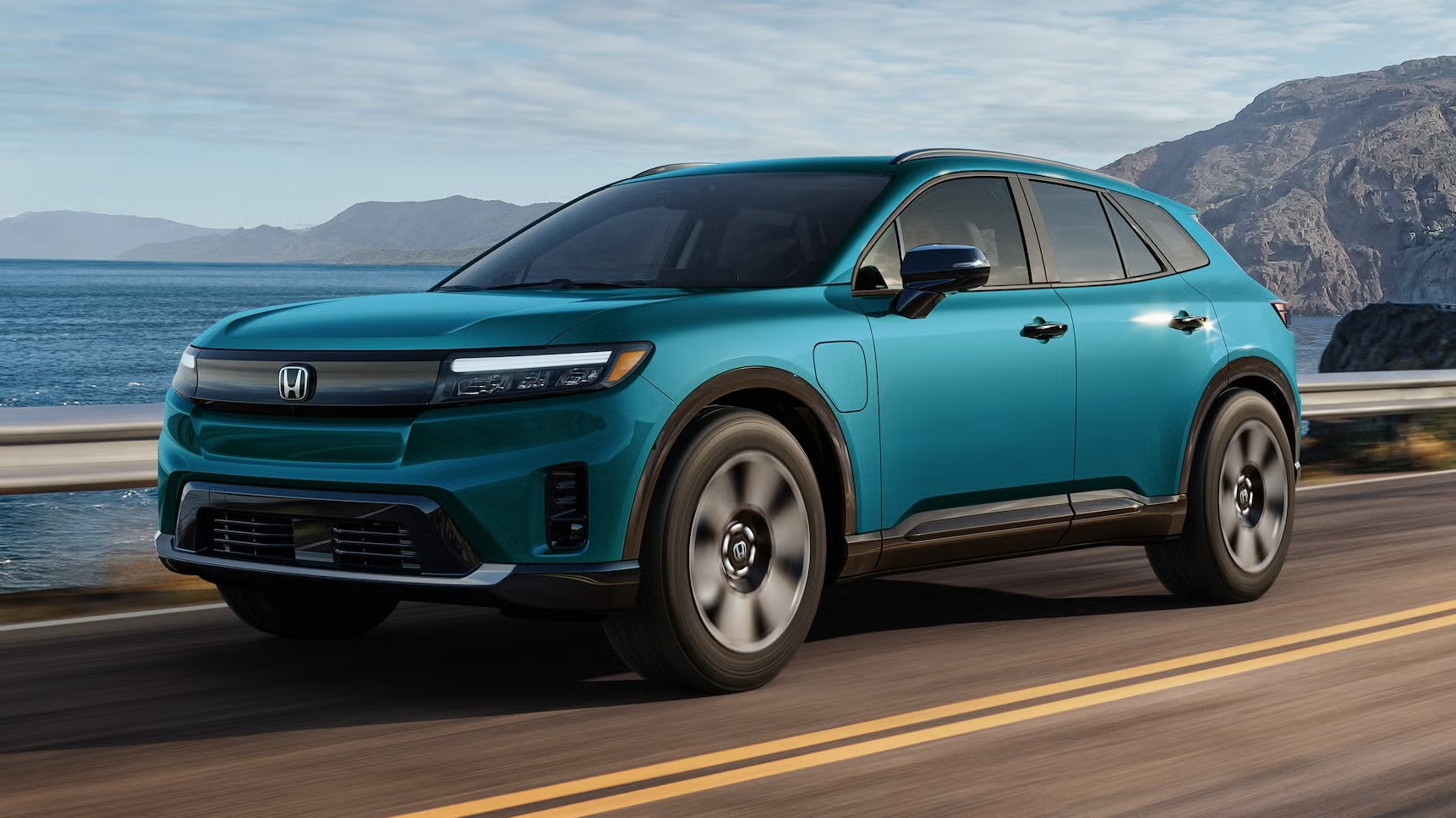
Honda and Nissan, Japan’s second- and third-largest automakers, are holding merger talks to create a structure that would enable them to better withstand fierce competition from the likes of Tesla and Chinese electric vehicle (EV) rivals, according to reports.
News agency Nikkei first reported that the two companies were holding merger talks to determine how they could cooperate more closely on technology. According to Reuters, the talks aim to set up an umbrella holding company and not necessarily merging the two companies together.
Mitsubishi, which Nissan has a 24% stake in, is also considered to be included in the partnership.
What’s for sure is that the two automakers have stepped up their cooperation in recent months as they seek a common strategy to address a fast-changing EV landscape.
Both Honda and Nissan separately issued a statement confirming this much. “As announced in March of this year, Honda and Nissan are exploring various possibilities for future collaboration, leveraging each other’s strengths,” the statement says.
Analysts believe Honda’s strengths in developing powertrains, notably for hybrids, could combine with Nissan’s experience in electric vehicles, which goes back to the LEAF in 2010.
The two automakers’ partnership has been centering on technology for EVs, including components and software.
What started as an alliance to face intense price competition from the likes of China’s BYD only intensified through the year as the global auto industry also recorded slowing sales in Europe and the U.S.
In addition, the industry is now facing the potential reversal of pro-EV policies in the U.S. with the incoming administration of President-elect Donald Trump.
The merger might also face scrutiny from the Trump administration, which has taken an aggressive stance on imported vehicles, including threats to impose steep tariffs.
A Honda/Nissan merger would yield one of the largest auto groups in the world, with combined sales of about 8 million.
BYD has launched the third-generation Qin Plus DM-i in China, and the first thing that caught my eye is its price. According to CarNewsChina, the plug-in hybrid sedan starts at 79,900 yuan, which is about $11,980. That’s an incredibly low price for a brand-new car, especially by US standards.
What’s even more impressive is the range. The Qin Plus DM-i can drive up to 137 miles on electricity alone, which should cover most people’s daily commutes without using a drop of gas. Once the battery runs out, the 1.5-liter engine takes over. Thanks to its 17-gallon tank and roughly 91 mpg with a drained battery, the combined range reaches up to 1,423 miles.
Apple won the PC market’s worst quarter, but that’s not the entire story. It won the race by stumbling less than everyone else.
PC makers shipped just 57 million computers worldwide in Q3, which might look good, but it’s a 21% year-over-year plunge (via Counterpoint Research). And despite Apple’s Mac shipments falling by 11%, to 5.6 million, its market share rose from 8.7% to 9.8%. How did that happen?
Update (October 22 23:54 PT): In response to our query, GM clarified that offline recording support is already available on eligible vehicles. Like Tesla's Sentry Mode, it requires owners to connect a USB drive to save incident recordings, which can be viewed on the vehicle's infotainment screen. The upcoming Connected Cameras feature will build on this by giving owners remote access to these recordings via the revamped OnStar app, allowing them to check footage without walking out to their car.
General Motors has announced plans to add a new Connected Cameras feature to its OnStar service starting next year, giving drivers a way to monitor parked vehicles remotely and capture footage of certain incidents.