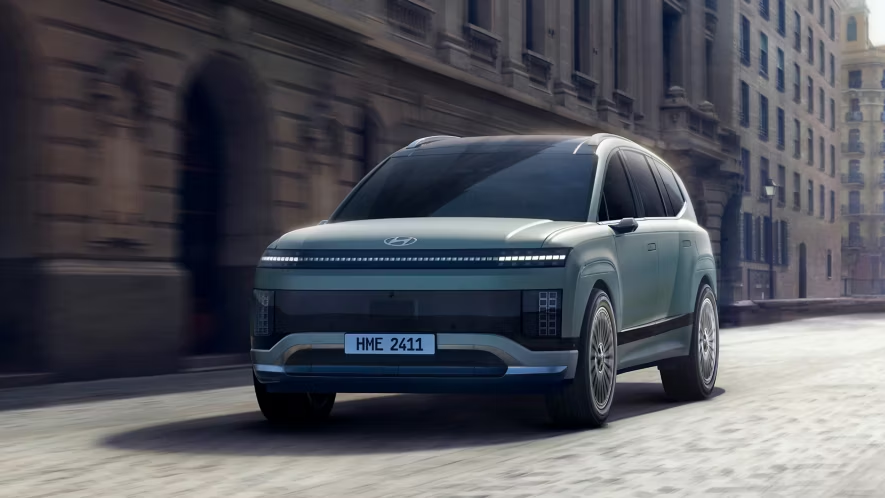
After months of teasing details about the Ioniq 9, Hyundai’s much-anticipated, three-row electric SUV, the company finally unveiled it at the Los Angeles Auto Show.
One of the Ioniq 9’s promised features — that the SUV had the ability to offer a lounge-like interior – had most of us wondering what exactly that might mean.
It all became much clearer after the launch: The second-row seats of the SUV can swivel around, providing enough space for a large lounge-like area.
The vehicle’s interior design is characterized by oval elements and calming tones, providing a serene and natural feel, especially when one is immersed in natural light from the panoramic sunroof, Hyundai says.
In addition, a slidable universal island provides ample storage and delivers a walk-through front-row seating arrangement, allowing for more accessibility and convenience. The bidirectional armrests can also be opened from the front and rear, allowing easy access to the console from the second row.
And the Ioniq 9’s relaxation seats feature a Dynamic Body Care System, which includes a massage function to “stimulate blood flow and circulation, reducing fatigue on long drives,” Hyundai says. The automaker, however, specified that these seats would be available in first and second rows, depending on the market.
The Ioniq 9’s 110.3-kilowatt-hour battery provides up to 335 miles of range on the Long-Range RWD model. The battery is able to charge from 10% to 80% in 24 minutes. As promised, the SUV also features Tesla’s North American Charging Standard (NACS) port.
As for the Ioniq 9’s price, no further details were so far provided, either at the auto show or on Hyundai’s website. But since the SUV will be built on the same platform as the Kia EV9, it’s expected to be roughly the same size and price ($55,000).
The Ioniq 9 is slated to go on sale in the U.S. in the first half of 2025, Hyundai says.
BYD has launched the third-generation Qin Plus DM-i in China, and the first thing that caught my eye is its price. According to CarNewsChina, the plug-in hybrid sedan starts at 79,900 yuan, which is about $11,980. That’s an incredibly low price for a brand-new car, especially by US standards.
What’s even more impressive is the range. The Qin Plus DM-i can drive up to 137 miles on electricity alone, which should cover most people’s daily commutes without using a drop of gas. Once the battery runs out, the 1.5-liter engine takes over. Thanks to its 17-gallon tank and roughly 91 mpg with a drained battery, the combined range reaches up to 1,423 miles.
Apple won the PC market’s worst quarter, but that’s not the entire story. It won the race by stumbling less than everyone else.
PC makers shipped just 57 million computers worldwide in Q3, which might look good, but it’s a 21% year-over-year plunge (via Counterpoint Research). And despite Apple’s Mac shipments falling by 11%, to 5.6 million, its market share rose from 8.7% to 9.8%. How did that happen?
Update (October 22 23:54 PT): In response to our query, GM clarified that offline recording support is already available on eligible vehicles. Like Tesla's Sentry Mode, it requires owners to connect a USB drive to save incident recordings, which can be viewed on the vehicle's infotainment screen. The upcoming Connected Cameras feature will build on this by giving owners remote access to these recordings via the revamped OnStar app, allowing them to check footage without walking out to their car.
General Motors has announced plans to add a new Connected Cameras feature to its OnStar service starting next year, giving drivers a way to monitor parked vehicles remotely and capture footage of certain incidents.