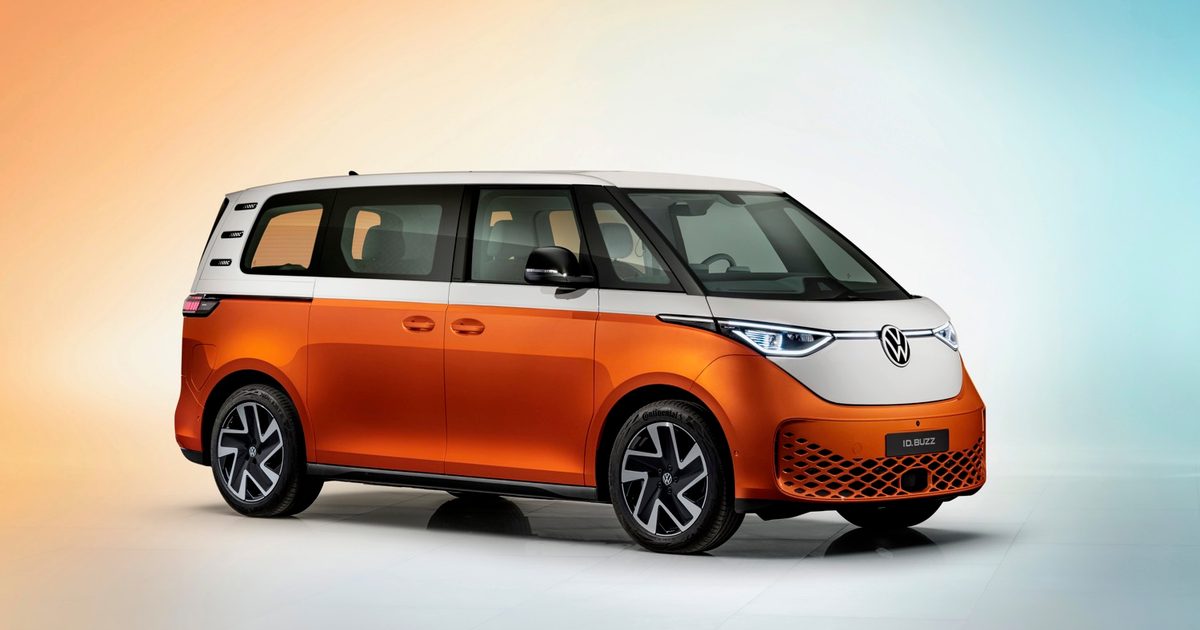
The original Volkswagen Microbus is an automotive icon, which might explain why VW has taken so long to launch a follow-up.
After showing multiple Microbus-inspired concept cars, VW unveiled an all-electric Microbus concept at the 2017 Detroit Auto Show, the promptly confirmed plans for a production version. While the world oohed and aahed at that concept (and we drove it), VW took its sweet time on the production model. The Volkswagen ID. Buzz finally made its debut online today, and still won’t go on sale in the United States until 2024.
Available in both passenger and ID. Buzz Cargo versions, this electric van combines styling inspired by the classic Microbus with modern tech and sustainable materials. It’s not just a retro fashion statement, either. The ID. Buzz was engineered by Volkswagen Commercial Vehicles, so it should appeal to tradespeople as well as hippies and surfers.
A decent amount of the 2017 concept car’s design remains, but the ID. Buzz production model is a bit more squared off, and a bit less cuddly-looking, than the concept. Some styling elements, like the two-tone exterior and large centered VW logo, are clear callbacks to the Microbus, but the ID. Buzz is far from retro.
VW couldn’t have done a modern Microbus if it wasn’t electric. The packaging flexibility of an electric powertrain allowed VW to keep the classic Microbus shape while meeting modern crash-test standards and maximizing interior space. The ID. Buzz also uses the same MEB platform as the VW ID.4, Audi Q4 e-tron, and other VW Group models. That allows VW to take advantage of economies of scale that wouldn’t normally be available to such a niche model.
The interior owes more to modern VW EVs than any 1960s hippie-mobile. The dashboard design looks largely the same as other ID-family EVs, but VW included a removable storage bin with compartments for everything from water bottles to laptops. VW also emphasizes sustainable materials, forgoing leather and using Seaqual yarn—a material made from recycled plastic—for the seat covers floor coverings, and roof liner. Exterior paint is also organically-based, according to VW.
Different form factor aside, the ID. Buzz gets largely the same interface as other recent VW models. That includes a 10.0-inch Digital Cockpit instrument cluster, ID.Light interactive lighting system, and multicolor ambient lighting. A 10.0-inch touchscreen is standard, while a 12.0-inch screen is optional. We expect wireless Apple CarPlay and Android Auto to be standard as well.
European models get standard forward collision warning, lane keep assist, and traffic sign recognition, along with optional adaptive cruise control, park assist, Emergency Assist (automatically slows the car if the driver becomes incapacitated), and Travel Assist, which adds automated lane centering to the adaptive cruise control. Similar features are already available on some U.S.-market VW models, so this list will likely carry over.
At 185.5 inches with a 117.6-inch wheelbase, the European-spec launch version is slightly smaller than passenger-carrying versions of the Ford Transit Connect and Mercedes-Benz Metris, but the VW is a bit wider than those vans. U.S. versions will be based on a longer-wheelbase passenger model scheduled to be unveiled in 2023.
The passenger version of the ID. Buzz will launch in a five-seat configuration, followed by a six-seat version with seats arranged in three rows of two. The long-wheelbase ID. Buzz destined for the U.S. will be available with seven seats across three rows. Finally, the ID. Buzz Cargo will offer up to 137.7 cubic feet of cargo space behind its rear seats — more than a Ford Transit Connect cargo van.
At launch, the European-spec ID. Buzz and ID. Buzz Cargo will have an 82-kilowatt-hour battery pack mounted under the floor and a single electric motor sending 201 horsepower and 229 pound-feet of torque to the rear wheels. VW quoted an electronically limited top speed of 90 mph but is mum on a zero to 60 mph time or range. Other battery-pack options with different power outputs will be announced in 2023, VW said.
The ID. Buzz will charge at 11 kilowatts using a 240-volt Level 2 AC charging station or 170 kW with DC fast charging. The latter enables a 5% to 80% charge in 30 minutes, according to VW. The ID.Buzz will also be compatible with Plug & Charge, meaning driving can start a charging session at a public station simply by plugging in.
In Europe, VW will also offer bi-directional charging, allowing the ID.Buzz to discharge power back into the grid. The automaker hasn’t confirmed this feature for the U.S., however.
While the ID. Buzz has finally been revealed, customers will have to wait a bit longer to buy one. Production for the European market is scheduled to start later in 2022, with the official European launch scheduled for the third quarter of the year.
The U.S.-spec ID. Buzz won’t be unveiled until 2023, with a sales launch scheduled for 2024. Because that’s so far out, VW isn’t ready to discuss U.S. pricing. The automaker did confirm the ID. Buzz will get an eight-year, 100,000-mile, battery warranty like the VW ID.4, though.
Related Posts
Tesla Model 3 got outsold by an EV from a Chinese smartphone brand

The Chinese smartphone maker delivered 258,164 units of its first EV. Meanwhile, Tesla sold only 200,361 Model 3s, marking the first time since Tesla's Chinese launch that another brand has overtaken it in the world's largest EV market.
Your future BMW electric M3 will still sound like a real M car

Instead of trying to invent a new "sound of the future" filled with abstract spaceship hums and digital warbles, BMW’s Motorsport division is digging into its own history books. New videos from the development team reveal that the upcoming electric M3 will feature a synthetic audio system built from high-fidelity recordings of the brand’s most iconic internal combustion engines. We aren't talking about generic engine noises here; BMW is literally sampling the legends.
This is the tech that makes Volvo’s latest EV a major step forward

The 2027 Volvo EX60 boasts engineering improvements in a package that’s likely to have mass appeal. It’s based on a new architecture that offers improved range and charging performance, backed by software with now-obligatory AI integration. And as a five-seat SUV similar in size to the current Volvo XC60 — the automaker’s bestselling model — it’s exactly the type of car most people are looking for.