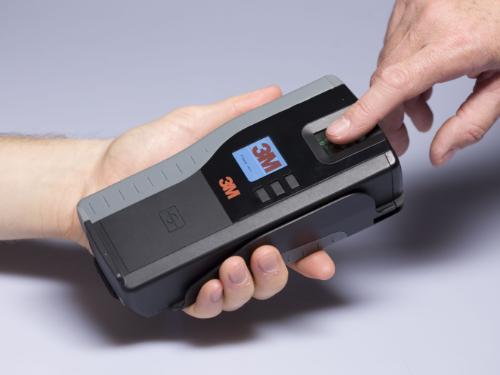
This type of reader device would most typically be used by border management, law enforcement and transportation. The product is being unveiled this week at the CARTES & IDentification event in Paris, and will be available commercially in early 2011. Pricing has not yet been announced for the device.
The first five-in-one device of its kind from 3M, the product is equipped with readers for optical character recognition (OCR), three-track magnetic stripes, contactless RF chips and contact chips, as well as an optical, single fingerprint capture device. Once the data is captured in any one of these five modes, the device encrypts and relays it via wireless Bluetooth technology to a user’s existing computer such as a laptop, tablet PC or smartphone.
The 3M MD6000 Mobile ID Reader gives users the ability to make real-time, field-based operational decisions, without having to call in ID checks to a local station. In a law enforcement application, for example, officers will have the ability to validate multiple forms of ID at a scene. In a border-control scenario, the reader will allow agents to check travel documents at entry or exit points.
The reader gives users greater flexibility to take advantage of future technology improvements in processors and communications devices without the need to replace reader equipment. With exceptional flexibility in how data is captured and processed, the 3M MD6000 Mobile ID Reader gives customers a lower cost and versatile tool for use in the field.
For more information about 3M Security Systems, visit www.3M.com/Security
Related Posts
New study shows AI isn’t ready for office work

A reality check for the "replacement" theory
Google Research suggests AI models like DeepSeek exhibit collective intelligence patterns

The paper, published on arXiv with the evocative title Reasoning Models Generate Societies of Thought, posits that these models don't merely compute; they implicitly simulate a "multi-agent" interaction. Imagine a boardroom full of experts tossing ideas around, challenging each other's assumptions, and looking at a problem from different angles before finally agreeing on the best answer. That is essentially what is happening inside the code. The researchers found that these models exhibit "perspective diversity," meaning they generate conflicting viewpoints and work to resolve them internally, much like a team of colleagues debating a strategy to find the best path forward.
Microsoft tells you to uninstall the latest Windows 11 update

https://twitter.com/hapico0109/status/2013480169840001437?s=20