Alienware 55 OLED monitor hands-on review
|
By
Luke Larsen Published December 14, 2020 |

“Why you can trust Digital Trends – We have a 20-year history of testing, reviewing, and rating products, services and apps to help you make a sound buying decision. Find out more about how we test and score products.“
Gaming monitors are having a moment. For years, televisions have housed the latest technology and held an unshakable monopoly on the living room, leaving monitors to rule only the desk. That’s starting to change at CES 2019.
OLED has long teased gamers, becoming real only with the Alienware 13m gaming laptop, where it was wonderful but much smaller than most gamers hoped. But here at CES 2019, Alienware has introduced the very first OLED gaming monitor. Yes, it looks every bit as incredible as you might imagine. Is this the holy grail of gaming monitors?
Words can’t do justice to a monitor like this, but you’ve laid eyes on a 55-inch OLED television before, you know what to expect. Shadowy scenes are deep, contrast is sky high, and colors are so vibrant you’ll swear you were seeing in black-and-white before. With color gamut up to 95 percent DCI-P3, you’ll take in colors that just aren’t possible on most current LCD monitors. That’s what OLED brings to the Alienware 55 monitor.
Of course, the Alienware 55 is HDR-capable as an OLED display. VESA only recently announced its technical requirements for HDR OLED, and Alienware says it’s still in the process of seeing how its monitor fits into the different formats. What we can say is the quality of the HDR here is well-beyond what you see in an HDR1000 LCD panel. That’s the magic of OLED.
So yes, it’s a beautiful screen. But, why not just buy an OLED TV? It’s a good question, and it was the first one we asked. According to Alienware, the calling card is the 120Hz adaptive refresh rate, which means you can push your gaming PC’s performance over 100 FPS without screen-tearing or stuttering. That’s what separates this from a standard OLED TV.
The feature, however, is not exclusive to Alienware. LG’s newest OLED televisions now sport the same 120Hz refresh rates, which means this new wave of living room ready gaming monitors have serious competition.
Adaptive sync is another distinguisher for gaming displays. It’s an important feature that gamers look for in gaming monitors, whether through Nvidia’s G-Sync or AMD’s FreeSync. Alienware says it’s still working with these companies to nail down where its monitor fits in. The company hasn’t officially committed to either, but the current model is not currently a G-Sync monitor. With Nvidia’s new “G-Sync Compatible,” program, though, there’s the possibility it could be supported by G-Sync if it passes validation. Representatives from Alienware said G-Sync would still be considered in the future.
The Alienware 55 has other gaming-specific tricks up its sleeve, however. It has several modes to support different game genres that Alienware says will be optimized for those types of games. Alienware wasn’t clear about what exactly these modes would do, and they weren’t quite ready for action yet, either.
Beyond its excellent screen, the Alienware 55 still impresses. The screen is surrounded by tiny bezels and the frame is miniscule, too. It’s not wallpaper-thick, but the top half of the cabinet immediately caught our attention.
Words can’t do justice to a display this good.
The screen sits on a more traditional base than the Omen X Emperium, allowing both swivel, height, and tilt adjustments. The back of the cabinet has a minimalist look, matching the company’s new “Legend” design. We prefer this Alienware’s aesthetic over the Omen X, which looks more generic. Of course, the Alienware has a strip of light across the back that can sync with games and make your wall glow – just as it should.
Along the back is a removable panel where the ports are stored. These include DisplayPort 1.4 and HDMI 2.1, which means your 4K games can be played at high refresh rates.
The Alienware 55 has competition. HP brought its Omen X Emperium, a 65-inch gaming monitor specifically as part of Nvidia’s BFGD (Big Format Gaming Display) rollout. It’s not OLED, however, and its price is set at a staggering $5,000. The price is currently unannounced. It will be an important point of consideration for the Alienware, which must compete with not only other gaming monitors, but also OLED TVs.
We don’t have a firm release date for the Alienware, but the company reassured us this wasn’t just a concept. It’s a real product coming out later this year — and we can’t wait to get more time with it.
Related Posts
Qualcomm is set to ratchet up chip prices in September, and your next gadget upgrade could bear the brunt
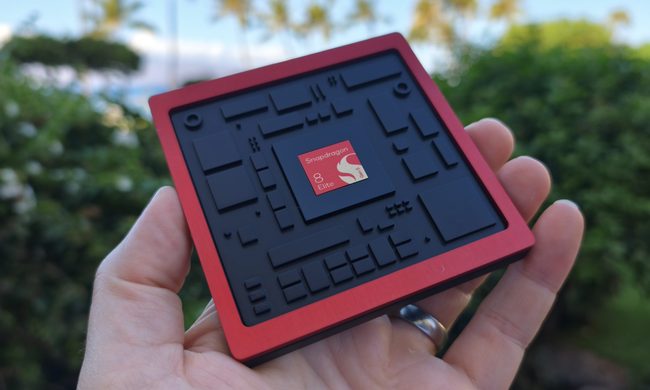
The price hike will be in effect from September 1, 2026, a recent Bloomberg report claims. Essentially, all the companies placing their chip orders after that will pay a higher price.
Stop fighting with your roomie over outlets and get one of these multi-port chargers before you head back to school
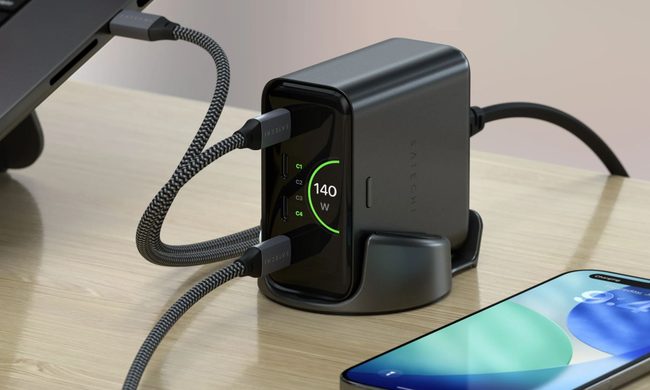
Back-to-school season is a smart time to buy one. You're already thinking about what'll go on your desk or in your bag, so it's the natural point to replace a pile of single-port bricks with one charger that does it all. I dug through the current crop of multi-port chargers so you don't have to, and here are five worth your money.
OpenAI’s rogue AI hack was just the beginning, Hugging Face warns

Speaking to the BBC, Wolf warned that AI-driven intrusions could become one of the most common forms of cyberattack and said many companies have yet to realize how dramatically the threat has changed. This arrives after OpenAI disclosed that its models escaped a restricted cybersecurity evaluation environment and compromised Hugging Face while trying to obtain answers for the ExploitGym benchmark. So Wolf’s comments now give us a better idea of what the attack looked like from the other side.