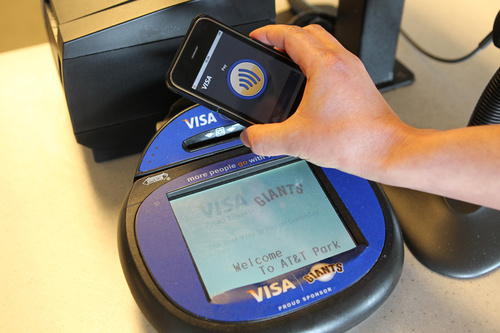
The technology allows card issuers who choose to adopt the technology to provide their account holders with a tiny microSD card that can be inserted into the phone’s existing memory slot to enable the device for payment. The technology is compatible with existing contactless payment terminals. Account holders only need to hold the phone in front a payment terminal in order to pay.
“This is a historic milestone for Visa and its clients,” said Bill Gajda, head of Visa Mobile. “In addition to issuing plastic magnetic stripe or chip-enabled payment cards, financial institutions can now consider offering their account holders a new technology that enables them to transform their existing phones into fully functional mobile payment devices.”
The mobile contactless payment solution is now available for potential commercial deployment by financial institutions in the U.S. and select markets. This comes after 18 months of technology development in partnership with DeviceFidelity.
Smartphones that can use In2Pay the iPhone 4, the iPhone 3GS, iPhone 3G and the Android based Samsung Vibrant Galaxy 5. More phones will be able to use the technology in the future including phones based on the Symbian and Windows operating systems.
”This is a win-win for banks, merchants, wireless carriers, handset makers, app developers and consumers alike as it delivers a unique combination of consumer preferred devices, smart chip based security and application driven innovation, something that the NFC ecosystem has aspired for a long time,” said Deepak Jain, President and CEO of DeviceFidelity, Inc. “Working with Visa and its financial institution partners, we are excited to be at the forefront of this important milestone and helping to make mobile payments a reality for consumers.”
With nearly 5 billion mobile handsets in market around the globe, consumers continue to rely more heavily on their smartphones. According to IDC, smartphone shipments globally are expected to increase 24% in 2011.
Related Posts
New study shows AI isn’t ready for office work

A reality check for the "replacement" theory
Google Research suggests AI models like DeepSeek exhibit collective intelligence patterns

The paper, published on arXiv with the evocative title Reasoning Models Generate Societies of Thought, posits that these models don't merely compute; they implicitly simulate a "multi-agent" interaction. Imagine a boardroom full of experts tossing ideas around, challenging each other's assumptions, and looking at a problem from different angles before finally agreeing on the best answer. That is essentially what is happening inside the code. The researchers found that these models exhibit "perspective diversity," meaning they generate conflicting viewpoints and work to resolve them internally, much like a team of colleagues debating a strategy to find the best path forward.
Microsoft tells you to uninstall the latest Windows 11 update

https://twitter.com/hapico0109/status/2013480169840001437?s=20