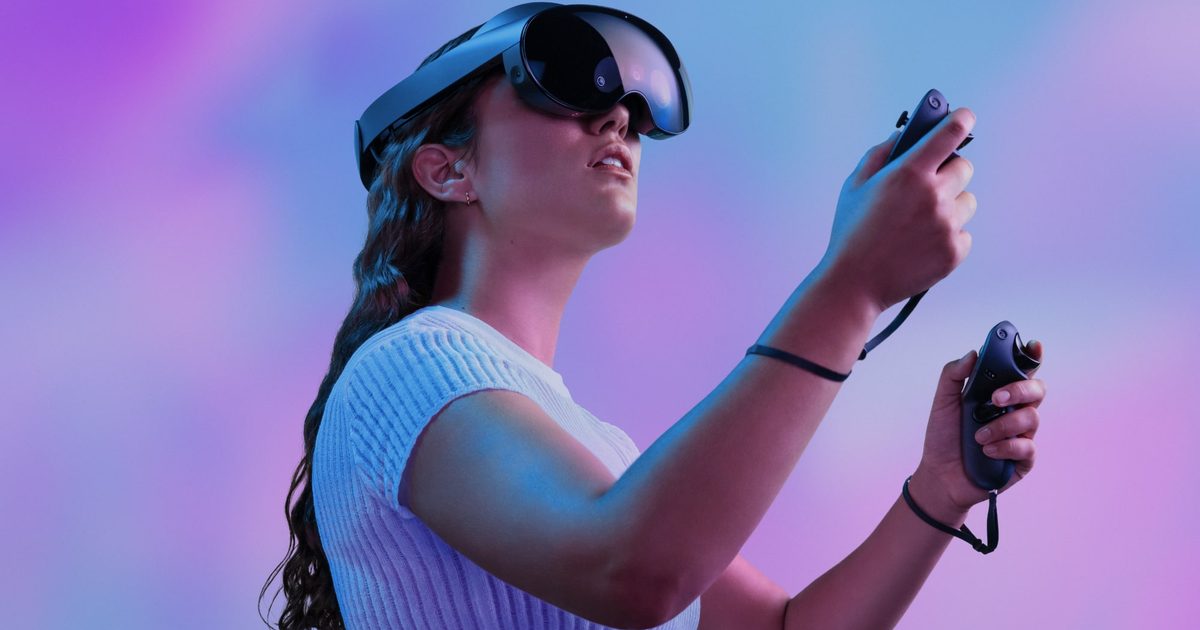
Meta is planning to launch its third-generation consumer VR Quest headset sometime late next year, the company confirmed during its Q3 2022 earnings call.
The current Meta Quest 2 has been a solid success for the company, being well-received by consumers and critics alike. It had been praised for its sharp display, strong performance, and intuitive control layout, but like almost anything, improvements are always welcomed. This is where the Quest 3 could really make a strong impression.
Technical details are mostly unknown for now, however, but we can hope for niceties such as a 120Hz refresh rate display, better graphics, and hopefully significantly longer battery life than the Quest 2. An improved processor could actually achieve all the said goals, potentially giving the Quest 3 the boost it needs, thus incentivizing development of higher-end games and software.
Another unknown is pricing. A possible clue is that Mark Zuckerberg, Meta’s CEO, had previously stated that the upcoming Quest headset would be somewhere “in the price range of $300, $400, or $500.” For the keen-eyed, that puts the Quest 3 at around the current retail price as its predecessor, once again pointing to the possibility of Meta subsidizing the cost of the Meta Quest 3, similar to what it did for the Quest 2. This move is designed to increase customer adoption into its VR products as well as the metaverse, while encouraging developers to create software for its platform.
Of course, the recently launched Quest Pro is a very different headset, more aimed toward mixed-reality use for work — not as much as a dedicated gaming headset.
Related Posts
New study shows AI isn’t ready for office work

A reality check for the "replacement" theory
Google Research suggests AI models like DeepSeek exhibit collective intelligence patterns

The paper, published on arXiv with the evocative title Reasoning Models Generate Societies of Thought, posits that these models don't merely compute; they implicitly simulate a "multi-agent" interaction. Imagine a boardroom full of experts tossing ideas around, challenging each other's assumptions, and looking at a problem from different angles before finally agreeing on the best answer. That is essentially what is happening inside the code. The researchers found that these models exhibit "perspective diversity," meaning they generate conflicting viewpoints and work to resolve them internally, much like a team of colleagues debating a strategy to find the best path forward.
Microsoft tells you to uninstall the latest Windows 11 update

https://twitter.com/hapico0109/status/2013480169840001437?s=20