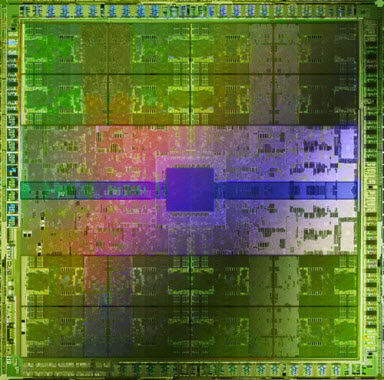
 Graphics technology developer Nvidia has formally introduced its next generation graphics architecture, codenamed Fermi, which Nvidia CEO Jen-Hsun Huang described as putting a supercomputer into a GPU. Unlike traditional GPUs, which are optimized for rendering and graphics tasks, the Fermi architecture is intended to put standard computing operations and graphics procedures on equal footing, enabling developers to leverage the computing power of the GPUs for things like physics simulation, supercomputing, and medical imaging…and, of course, there will still be some applications for gaming.
The Fermi chip currently sports some 3 billion transistors—which compares to 2.3 billion in Intel’s quad-core Itanium and eight-core Nehalem-EX CPUs—and 512 cores, offering eight times the double-precision floating-point performance of previous generations: fast floating point operations are key in many physics simulations. The card can support up to 6 GB of GDDR5 memory, and has six 64-bit memory partitions totaling a 384-bit memory interface. Nvidia is promising developers will be able to tap into the Fermi board using C++ and a Visual Studio development environment dubbed Nexus; the board also offers ECC memory support for catching memory read/write errors.
Nvidia is due to release a beta of Nexus on October 15, although it has not offered any release date or pricing for Fermi products.
Industry watchers generally see Nvidia’s move towards high-performance computing as a good one for the company; although it will face stiff competition from Intel, AMD, and system integrators like HP and Dell, Nvidia’s architecture is sufficiently unique that it could potentially carve out a niche for itself in specialized fiends like climate prediction and image processing and analysis—and margins in the high performance computing market are considerably higher than consumer graphics controllers.
In 1950, Alan Turing asked whether machines can think. Rather than argue over definitions, he turned the question into a party game, where an interrogator trades typed messages with hidden players and tries to work out who is who. Since then, chatbots have gotten so good that they have already fooled humans in modern versions of the test.
So, four researchers from Paris Cité University asked the obvious follow-up question in a new study published in Computers in Human Behavior Reports: can AI at least catch its own kind?
Mozilla is giving Firefox’s Smart Window two new tricks. If you haven’t tried it yet, Smart Window is an optional AI mode in Firefox with a built-in chat that helps you get things done while you browse. With this update, it can fill out online forms using details from your tabs and keep an eye on websites for you.
Tired of typing the same details into every form?
The absolutely absurd idea of putting a touchscreen display on a mouse isn't exactly new. Turtle Beach already did it with its Command Series MC7, which features a 2.25-inch control screen. But apparently, even that wasn't ridiculous enough for Arctic Fox Technologies. Its new Super Mouse looks like someone took the chunky old Atari ST mouse, slapped a touchscreen and scroll wheel on it, and called it an upgrade.
The result is a rather unusual-looking mouse that is now on Kickstarter, starting at $199. And as ridiculous as it looks, some of its features are genuinely intriguing.