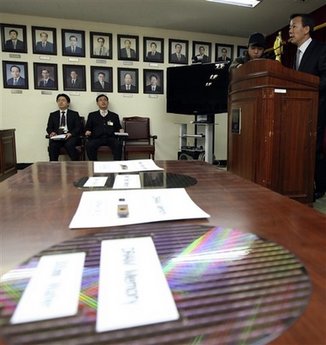
The world’s top producers of computer memory chips are embroiled in an apparent case of industrial espionage after South Korean prosecutors indicted 18 people over alleged technology theft. Prosecutors said Thursday those involved — including employees of U.S. company Allied Materials and its South Korean unit — are suspected of leaking semiconductor technology belonging to South Korea’s Samsung Electronics Co. to its domestic rival Hynix Semiconductor Inc.
The case highlights the intense competition among chipmakers and other sellers of high tech products, who frequently sue each other over alleged patent infringements. Samsung and Hynix are the world’s top two producers of dynamic random access memory, or DRAM, chips, used mostly in personal computers. Suwon, South Korea-based Samsung is also the world’s biggest manufacturer of NAND flash chips, used in digital devices such as cameras, music players and smartphones. Hynix ranks No. 3 in NAND, behind Samsung and Japan’s Toshiba Corp.
Prosecutors indicted 18 people on Wednesday, though 14 were not physically detained ahead of trial, said Kim Yeong-cheol, a prosecutor handling the case. He said prosecutors were also seeking a former Samsung employee for questioning. The technology is believed to have been obtained by employees of the South Korean arm of Applied Materials Inc., a U.S. company that makes equipment for chip manufacturers including Samsung, and then passed on to Hynix, according to prosecutors.
The local operation of Applied Materials had access to Samsung’s “core technology” through installing and maintaining the company’s chip manufacturing equipment, prosecutors said in a statement Wednesday. Indicted and being held were one employee each from Samsung and Hynix, the former head of the South Korean arm of Applied Materials — who currently serves as a vice president of the U.S. company — and one of the South Korean unit’s current employees, prosecutors said.
Kim, the prosecutor, said no decision has been made whether to seek extradition of a former Samsung employee who is working for Applied Materials in the United States. That person is suspected of leaking Samsung technology to Applied’s South Korean arm, Kim said. Santa Clara, California-based Applied Materials said it was aware of the actions by prosecutors and confirmed that its vice president and some employees of Applied Materials Korea were indicted and detained.
“Applied believes that there are meritorious defenses to the charges and is taking appropriate measures to address this matter,” the company said in a filing to the U.S. Securities and Exchange Commission on Wednesday.
“Applied has strict policies in place to protect the intellectual property of its customers, suppliers, competitors and other third parties, and takes any violation of these policies seriously,” the company said. Samsung, meanwhile, said it was concerned over the case and Hynix expressed “great regret.”
“We are very concerned by this transgression as it is likely to damage the semiconductor market,” Samsung spokeswoman Lee Soo-jeong said. “We plan to take appropriate measures.”
She said she could not confirm whether a Samsung employee had been arrested.
“Hynix expresses its great regret that our employees have gotten involved in this case,” said spokeswoman Park Seong-ae. “We expect that the facts of the case shall be strictly investigated and clearly revealed.”
Park confirmed the arrest of a Hynix executive in the case, but did not elaborate.
Related Posts
New study shows AI isn’t ready for office work

A reality check for the "replacement" theory
Google Research suggests AI models like DeepSeek exhibit collective intelligence patterns

The paper, published on arXiv with the evocative title Reasoning Models Generate Societies of Thought, posits that these models don't merely compute; they implicitly simulate a "multi-agent" interaction. Imagine a boardroom full of experts tossing ideas around, challenging each other's assumptions, and looking at a problem from different angles before finally agreeing on the best answer. That is essentially what is happening inside the code. The researchers found that these models exhibit "perspective diversity," meaning they generate conflicting viewpoints and work to resolve them internally, much like a team of colleagues debating a strategy to find the best path forward.
Microsoft tells you to uninstall the latest Windows 11 update

https://twitter.com/hapico0109/status/2013480169840001437?s=20