
Dorian Satoshi Nakamto, the 64-year-old California man alleged in a recent Newsweek cover story to be the creator of Bitcoin, has hired legal representation, reports the LA Times. He has also released a public statement to “unconditionally deny” the magazine’s story and any involvement with the popular cryptocurrency.
The statement, provided to media outlets by attorney Ethan D. Kirschner and first published in a tweet by Reuters’ financial columnist Felix Salmon early Monday, was released “to clear my name,” wrote Nakamoto.
“I did not create, invent, or otherwise work on Bitcoin,” Nakamoto continued. “I unconditionally deny the Newsweek report.”
The statement follows Nakamoto’s earlier denial, given in the hours following the publication of Newsweek’s article, to the Associated Press. Nakamoto’s statement does not specifically address the claim by Leah McGrath Goodman, author of the Newsweek article in question, that Nakamoto vaguely confirmed his involvement in Bitcoin by telling her, ““I am no longer involved in that and I cannot discuss it. … It’s been turned over to other people. They are in charge of it now. I no longer have any connection.” That quote served as Newsweek’s primary piece of evidence that Dorian Nakamoto created Bitcoin.
Newsweek has consistently stood by its story and McGrath Goodman.
Here’s Nakamoto’s full letter:
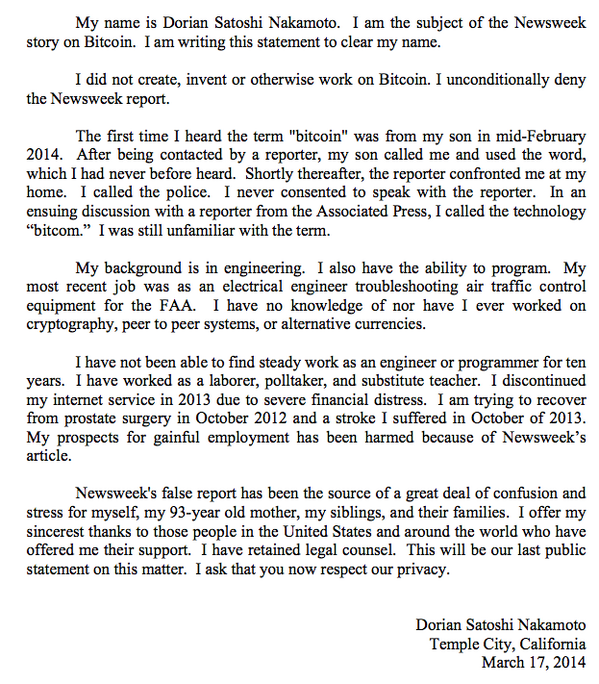 In case you missed it, Nakamoto says that, due to an inability to find proper work, he cancelled his Internet service in 2013 because of “severe financial distress” – not exactly what you would expect from someone reportedly worth hundreds of millions of dollars in Bitcoin. Nakamoto also says Newsweek’s article has “harmed” his chances of finding new employment, which some believe is a prelude to a lawsuit against the publication.
Immediately following the publication of Newsweek’s “The Face of Bitcoin” article, the Bitcoin community began to punch holes in the story due to its lack of concrete evidence proving that Dorian S. Nakamoto is the same “Satoshi Nakamoto” – a name long considered a pseudonym – who authored the original paper on Bitcoin and helped in the digital currency’s development before disappearing entirely in 2011.
In the aftermath of the Newsweek report, an account used by the “real” Satoshi Nakamoto came back to life, briefly, with the posting of a single sentence: “I am not Dorian Nakamoto.”
In response to Nakamoto’s statement, Newsweek says it “has not received any statement or letter from either Mr. Nakamoto or his legal counsel,” and will not respond until it does.
AI companies spend enormous amounts of time convincing us their technology is safe and secure. But what happens when those same companies become targets of increasingly sophisticated AI-powered attacks? Anthropic, the company behind Claude, is now facing that question. According to a Washington Post report, cybersecurity startup Cathedral discovered vulnerabilities that let its researchers access sensitive information in Anthropic's internal systems.
The researchers used AI agents to identify potential entry points in less than 12 hours. Interestingly, they didn't need to crack Claude itself. Instead, they exploited weaknesses in third-party business applications that Anthropic uses for everyday operations. Anthropic's security testing program disclosed the findings, which allows outside researchers to identify and report vulnerabilities.
Military working dogs charge into places the rest of us would flee. So, I understand why anyone would want to breed tougher, healthier dogs for the job.
Warhound, a new startup from Colossal Biosciences co-founder Ben Lamm and Anduril co-founder Palmer Luckey, has stepped out of stealth with $200 million to clone and gene-edit working dogs for American troops, police departments, and emergency services (via TechCrunch).
AI can describe a picture, identify objects, and answer questions about what a camera sees. But when a blind user needs a quick answer, getting an entire spoken essay about the scene isn't exactly helpful. Researchers at the University of Maryland (UMD) have found that AI-powered visual assistance can leave blind users doing too much work to get the information they actually need.
The study, titled Say It My Way: Exploring Control in Conversational Visual Question Answering with Blind Users, examined how people interact with Be My AI, an AI-powered feature of the Be My Eyes app. The researchers found that users often received lengthy descriptions that didn't adequately address their immediate goals, forcing them to ask follow-up questions or find ways to steer the AI towards a more useful answer.