
 Following the increased gang rape and murder incidents in India from the past few months, three engineer students from the SRM Institute of Science and Technology in Tamil Nadu, India have created an anti-rape underwear capable of delivering 3,800 kilovolt shocks to potential assailants. The undergarment is also designed to track the wearer’s location by GPS and can send text message alerts to police or family in case of emergencies.
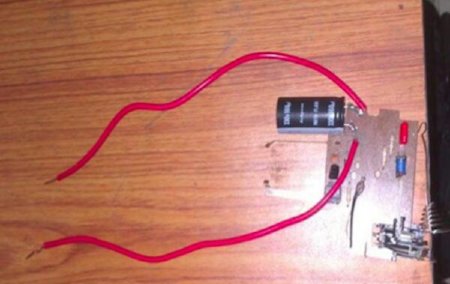
Called the Society Harnessing Equipment (SHE), the system is essentially just wire sensors with an electric circuit board attached to a camisole. When worn under clothes, the sensors can detect unwanted force (how exactly this differs than a friendly hug is unclear) and deliver up to 82 shocks to the would-be attackers. The team said they built the sensors around the bust area because a survey from law enforcement officials and women say attackers generally go for the chest area first before they are able get to the woman’s underwear.
 “Studying in a convent girls school, we were always taught to be good to everyone around and bear a cheerful smile. After stepping into the real, cruel world we realized that our smile could not last for long as the threat to our purity and integrity always lingered on,” the team, consisting of Niladri Basu Bal, Manisha Mohan, and Rimpi Tripathi explained the thought process behind SHE. The female engineers of the team cited that current laws are not enough to keep women safe. “We have initiated the idea of self‐defense which protects the women from domestic, social and workplace harassment… [and] decided to make this project which can be implemented easily.”
The undergarment comes with a layer of polymer underneath the circuits to keep the wearer safe from the shocks, and sends a message for help as necessary. “A person trying to molest a girl will get the shock of his life the moment pressure sensors get activated, and the GPS and GSM modules would send an SMS (to the Indian emergency number) as well as to parents of the girl,” Mohan says.
SHE recently won the Gandhian Young Technology Innovation Award, and will be mass produced by the end of the month. Hopefully, such innovation will keep both locals and tourists safe from unwanted force and bring positivity back to the nation. According to NBC, a recent study found that tourism rates in India have declined by 25 percent in the last three months, with the number of female tourists down by 35 percent. Though there are some potential flaws in the device (rain? What if the attacker rips the garment off first?), the solution is better than nothing.
San Francisco startup Dimensional advertised for people to walk robot dogs through city streets. The New York Times reported that the job could include carrying a roughly 33-pound robot back to the office if it overheated. A lift home is an awkward requirement for a labor-saving machine.
Keeping the hardware running is only one challenge. Anthropic's robotics tests found that language models mostly failed when controlling joints directly, but did better when directing trained controllers. Giving an AI agent a body doesn't teach it to handle ordinary household objects.
Soon, a mattress protector may be more than a bed cover. Australian medtech company Sleeptite and researchers at RMIT University have received a US patent for FlexiSense, a smart bedding technology that tracks body position and posture to help caregivers identify when older residents may be at risk of falling.
The technology is being developed for Sleeptite’s in-bed monitoring system, REMi, and was recently on display at The MedTech Conference in Boston. A peer-reviewed study in Flexible and Printed Electronics says the sensors can also be made at scale without sacrificing performance or durability.
AI companies spend enormous amounts of time convincing us their technology is safe and secure. But what happens when those same companies become targets of increasingly sophisticated AI-powered attacks? Anthropic, the company behind Claude, is now facing that question. According to a Washington Post report, cybersecurity startup Cathedral discovered vulnerabilities that let its researchers access sensitive information in Anthropic's internal systems.
The researchers used AI agents to identify potential entry points in less than 12 hours. Interestingly, they didn't need to crack Claude itself. Instead, they exploited weaknesses in third-party business applications that Anthropic uses for everyday operations. Anthropic's security testing program disclosed the findings, which allows outside researchers to identify and report vulnerabilities.