“Why you can trust Digital Trends – We have a 20-year history of testing, reviewing, and rating products, services and apps to help you make a sound buying decision. Find out more about how we test and score products.“
Civilization games always grab me right from the first turn because of the potential they hold. I can have strategies for my campaign in mind, but I have to dynamically react and reshape my plans as I discover new areas, grow my cities toward specific resources, and meet other civilizations that could become friends or foes. Sid Meier’s Civilization VII does nothing to sully that fantastic core formula; in fact, it found a way to give me that feeling multiple times over.
If you’ve played a Civilization game before, you’ll generally know what to expect from Civilization VII as the core building blocks of this Firaxis franchise haven’t changed, although Firaxis keeps finding clever ways to keep that formula fresh. In the case of Civilization VII, it does so by leaning into giving players the tools to craft emergent stories of their own.
Games are now split into three Ages, each of which can provide a fresh start and new opportunities for players as their efforts are reborn into a new civilization. While Civilization VII certainly favors those who play aggressively, and some aspects of its narrative delivery aren’t as impactful as they could’ve been, I still had loads of fun conquering the world, partaking in the space race, and more.
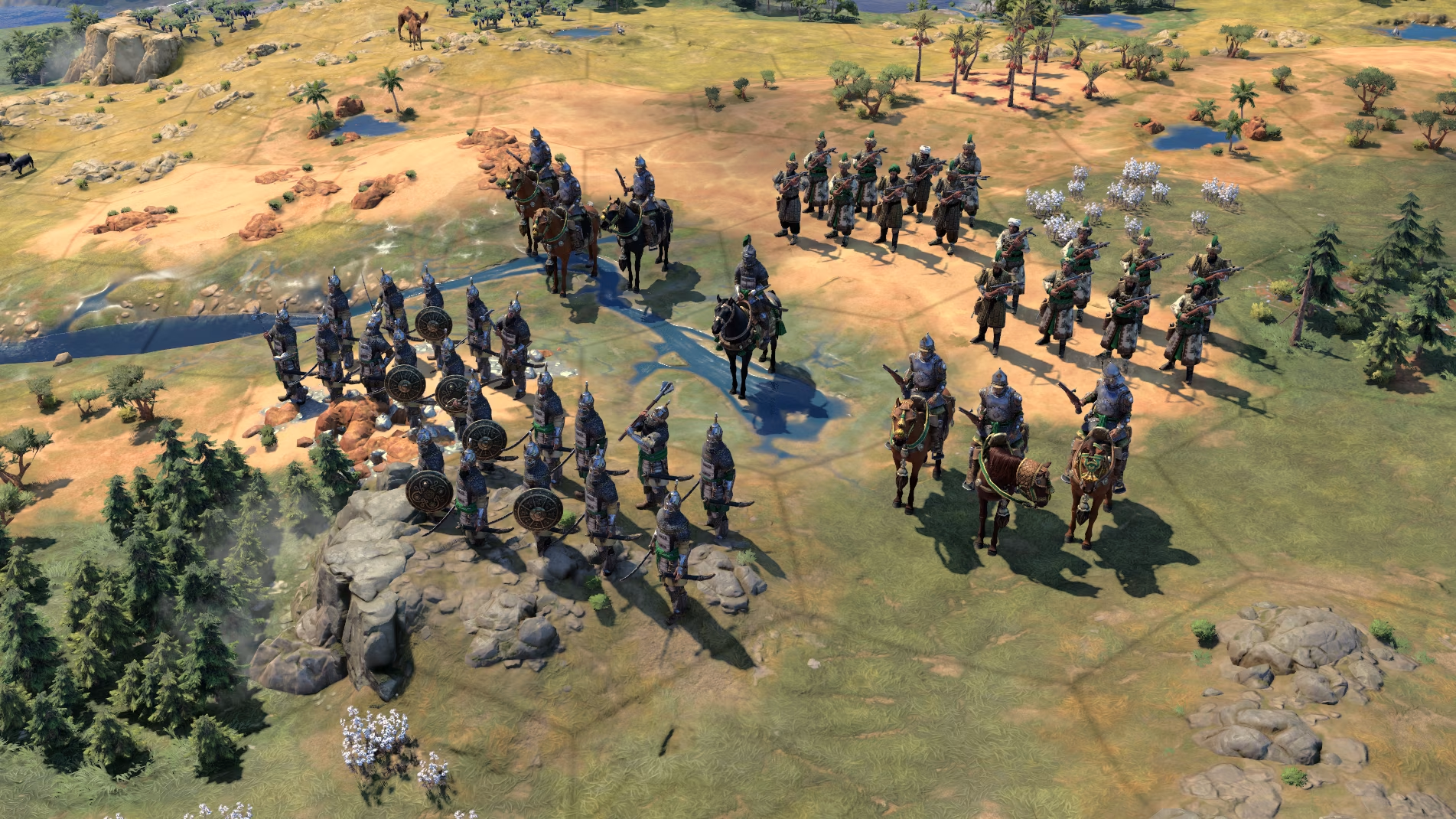
Civilization VII is a 4X strategy game, meaning that its core game loop tasks me with exploring the land around my starting city, expanding my territory through conquest, exploiting the resources my city encompasses, and exterminating any opponents I encounter. Concurrently, I’m researching technologies and civics to enhance my civilization’s capabilities and focusing on a cultural, military, scientific, or economic Legacy Path to achieve victory.
Depending on the civilization and leaders I chose, there are even further permutations in my abilities and the available units and buildings to create. As I have experience with previous Civilization games, I settled right into this and quickly became a continent conqueror. While 4X games typically have an approachability problem, that is not true for Civilization VII. There’s not as much to micromanage here as there is in a game like Ara: History Untold; commanding units, expanding my cities, and building structures all feels intuitive.
There’s a flurry of informative tutorials to opt into and a massive glossary I can sift through at any time if I have a question about something specific. On top of that, there are culture, military, science, or economic advisors who offer pointers on which buildings or units to build and what objectives to complete. While following precisely what they recommended meant I wouldn’t maximize the potential of my civilization, that wasn’t required for victory.
Instead, these recommendations provide me with a clear path to success; that process could make even novice players feel like strategic masterminds when playing Civilization VII. If you’ve bounced off the likes of Ara: History Untold, Frostpunk 2, or Humankind due to their complexity, I’d still recommend giving Civilization VII a shot as an enlightening gateway into the 4X genre.
While Civilization VII feels approachable from an expert and novice perspective, it boldly evolves the series’ formula in surprising ways, mainly through the Age system. Playthroughs of Civilization VII are split into three distinct ages: The Antiquity Age, the Exploration Age, and the Modern Age. I had to make my way through those ages in order, with a transition happening whenever I completed enough Legacy Path objectives.
The Antiquity Age encompasses the start of the game; that’s where I founded my first city, engaged in some smaller skirmishes and wars, and settled on pursuing a military victory. In the Exploration Age, I expanded my empire, taking over the continent I started on and breaching the new world. In the Modern Age, playthrough victory came into sight, and I started a mad dash toward that as the technology and civics I was researching started to feel more applicable to the modern day.
Age transitions cancel out any wars in progress, providing me a fresh start to work through every time. I found the Exploration Age the longest and most grueling to get through, but I had the most fun with the powerful technologies of the Modern Age. Each Age has its own resources, civics, technologies, units, buildings, and narrative events; more importantly, I also played as a different Civilization in each Age.
Civilization VII’s boldest change might be that players are no longer in control of one civilization the entire time. Instead, leaders and civilizations are chosen independently, and players choose a new civilization with each Age. I could start my playthrough as Persia and end as Prussia. It’s a neat idea, and it feels more similar to how Humankind handled its civilizations than how Civilization VI did. It puts a significant twist on what’s otherwise a fairly familiar formula, and the effects of this decision ripple throughout the rest of Civilization VII.
There are pros and cons to this approach. It certainly adds to the unique feeling of each Age, and seeing the wonders and ageless buildings I erected for a previous civilization in one Age to the next was rewarding. It also adds visual variety, so things don’t look stale ten hours into a campaign. That said, I generally felt more detached from the civilization I chose than I did in previous games.
In my favorite game in the series, Civilization V, I felt like I was bringing my specific civilization to new heights with each passing turn. Playing Civilization VII felt more like mastering a character in a hero shooter, as I found ways to best utilize their buffs with the special abilities of my civilization each Age to maximize growth. That’s a little disappointing, so I hope individual civilizations become more memorable as I continue to play this game. While I might not have felt as attached to the individual civilizations I controlled, I did feel more involved in the personal narrative of my playthroughs than ever before.
Taking cues from games like Frostpunk 2, narrative events are frequent and often ask players to make choices for different rewards. These added more flavor to my playthroughs, as did the emergent moments that arose based on the alliances I forged and the wars I waged. This feeling was only enhanced in multiplayer when I could talk to the people behind other civilizations as they dealt with their own emergent skirmishes, narrative events, natural disasters, and more.
Another shortcoming of Civilization VII, especially on lower difficulties, is that taking a militaristic approach feels overpowered. Whenever I singularly pursued military-focused goals in a playthrough, my power would quickly snowball, and I’d feel confident in an endgame victory by the middle of the Exploration Age. Victories were possible when I decided to pursue other Legacy Paths, but I felt like I always needed a strong military regardless. Civilization games have always rewarded more aggressive play, but Civilization VII, in particular, might be too finely tuned to favor that.
There’s room for Civilization VII’s gameplay to improve and grow over time, but it will do so from a strong core. Firaxis also won’t need to do much to touch up the presentation of Civilization VII, which is terrific. Gwendoline Christie is my favorite Civilization narrator yet, as she puts passion and grandeur behind every piece of narration she reads.
The soundtrack is wonderful, incorporating all kinds of instruments and sounds from around the world to create a soundscape distinct from any other one I’ve listened to in a strategy game. I often play games like this with headphones off, but I’m always tempted to put them on each time I boot this game up.
I also have a reason to come back to the game outside of liking how it plays now because of the meta-progression Firaxis added. By completing challenges during playthroughs — like doing a certain number of independent actions — players earn experience for Foundation and Leader Paths. Progressing through these unlocks player card customization options and Momentos that can give leaders small buffs during gameplay. Currently, Civilization VII features no microtransactions related to this system, and I hope it stays that way, as it’s nice to get some small rewards for committing so much time to the game.
Civilization VII is a game I see myself spending a lot of time playing in the future, even now that this review is done. Firaxis found creative ways to make the well-polished Civilization formula feel fresh with all the changes the Ages system brings with it. I’ve only scratched the surface in terms of the sense of discovery that it can offer, and that isn’t even accounting for all of its expected post-launch DLC. Civilization VII is a worthy bearer of this franchise’s name, and I’m intrigued by all of the potential places Civilization can go from here.
Sid Meier’s Civilization VII was reviewed on PC with a code provided by the publisher.
Google Play is borrowing one of the Nintendo Switch’s most useful little tricks. A new Sidekick tool called Playbacks captures a short clip after something interesting has already happened, sparing players from running a screen recorder throughout an entire game.
Playbacks is part of Google Play Store v53.8 and keeps saved clips on the phone. Google first announced it earlier this month, but the new Play Store update marks its arrival for players. Anyone who has watched a perfect win vanish because the record button came too late already understands the appeal.
Imagine tapping a Zelda icon on your iPhone and jumping straight into Hyrule. A new open-source project called nxnative makes that possible by repackaging Switch games you’ve bought into apps for iPhone, iPad, and Mac, with no emulator in the middle.
Why does this run so well on Apple devices?
The Call of Duty franchise has held a special place in my heart ever since I played my first Black Ops game back in 2010. That game's campaign was something else, with twists and turns that culminated in a mind-blowing finale. We can all admit that compared to those older campaigns, the recent CODs have been lackluster at best, and a complete and utter disappointment at worst. The reboot of Modern Warfare did give me some hope, as the first two installments were actually quite good, but the third game left such a bad taste in my mouth that I wasn’t exactly expecting much from Modern Warfare 4.
After recently finishing the campaign, I can say that this installment is nothing like the recent releases and instead feels closer to the franchise’s roots. For the first time in a long while, the campaign comes across as well-crafted rather than rushed to hit a release date. It arrives three years after MW3, and you can see exactly where all that time went. It seems the studio finally made listening to player feedback a priority.