
 I’ve never had a “running from zombies” nightmare that ended with me being eaten because my body stopped responding to my brain, but I expect that things will now be different after playing through Tequila Works’ Deadlight. The post-zombie apocalyptic survival game may boast some exceedingly high production values, but its collection of beautiful dystopian tableaus aren’t enough to prevent you from frequently dropping your controller in frustration as you succumb to another horde of zombies — or “Shadows” as they’re called in the game — or another poorly timed jump.
Deadlight has been framed throughout its development as a side-scrolling survival horror game, but the game really has more in common with old-school platformers like Mega Man or Prince of Persia than it does with the likes of Silent Hill or Resident Evil. Sure, there’s a bit of resource management and you’re constantly fighting with the clunky controls — not by design, I would wager — but you’ll more often than not find during the exceedingly brief two-hour play time that the biggest challenge you face is a tired gauntlet of trial-and-error repetition. There’s certainly an audience for that sort of interactive experience, though the Mega Man 10-loving mutants of the world will probably find Deadlight just a bit too easy for their tastes.
The story is set in an alternate 1986, opening a world that’s been ravaged by some unspecified plague that turns average humans into mindless, cannabalistic beasts. One bite from an infected Shadow is enough to doom a person to the same fate. These Shadows are slow movers until they find a food source, at which point they lift themselves up and assemble into a shambling horde. So yes, while the game never once uses the Z-word, we are, for all intents and purposes, dealing with zombies here.
The 1986 setting adds a cool dynamic, since turning the clock back to a pre-Internet age allows Tequila Works to avoid having to explain away potential lifelines like cellular service and global positioning systems. The world’s infrastructure completely collapses when the Shadows take over, and many of the more well-armed survivors band together to create a New World Order for themselves. All of this plays out at the periphery of the story, mind you; there are some encounters with unfriendly humans in the late-game, but most of the challenges that you’re tackling involve puzzles built around the environment and the behaviors of the Shadows.
Deadlight is strongest in the presentation department. The side-scrolling action benefits from a highly stylized dose of photorealism that leans heavily in the direction of silhouette and shadow play. That visual aesthetic is sometimes detrimental to the play, since it’s easy to overlook important Next Steps for a given puzzle when the solution is a slightly lighter-colored bit of shadowy scenery against a background of darker shades. The visual execution is impressive overall though, and it helps ease the frustration of uncooperative controls.
I’d also have words of praise for the overarching narrative if the moment-to-moment writing didn’t feel so clumsy and, occasionally, at odds with the sharp visual presentation. No spoilers, but there’s a reason you’re running and leaping your way through the ruins of Seattle, something with a bit more substance than “escape the zombies.” The big picture plot points take some well-earned turns, but the writing around the dialogue and monologuing is clunky at best, mood-killingly laughable at worst. The game’s final cutscene is perhaps the biggest offender, which is a shame since it’s also meant to be the point at which all of the story’s scattered pieces come together.
The biggest obstacle to having fun, however, is how the game controls. If you’ve played any of the older, side-scrolling Prince of Persia games, then Deadlight should feel immediately familiar. There’s a fatigue meter that limits how much time you can spend dangling by your arms and how many times you can swing your axe at approaching Shadows, but the basics of running, jumping, and climbing are definitely in the style of the older game.
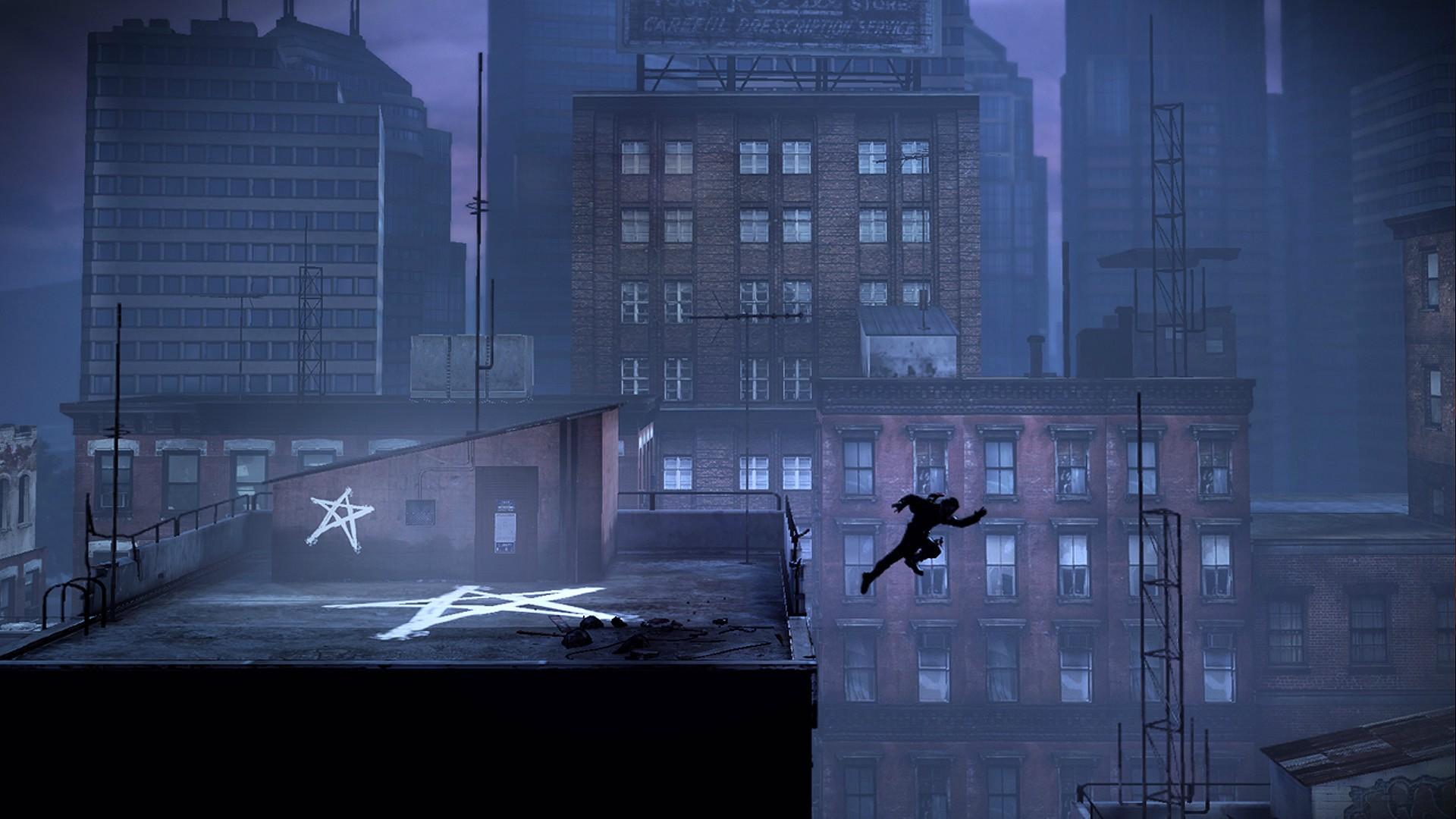 That’s not a happy comparison. The controls are responsive enough for running around and leaping through windows, but any fine-tune navigation requires a bit more patience. Time too, and that’s a commodity you often don’t have much of as a horde of Shadows approaches. The early puzzles are the strongest, since they rely less on pinpoint timing and more on observing the environment around you and not acting until you’ve formed a plan. Later on you frequently face an invisible ticking clock of some kind, and the trial-and-error repetition sets in. Pattern recognition and memorization become more important than raw skill, and the quality of the experience diminishes.
Of course, “later on” is a relative term when applied to Deadlight, since you can easily finish the game in approximately two hours (my own playthrough clocked in at 1hr 58min). There’s not much to come back for either. Most of the levels hide an assortment of collectibles, the best of which are three unlockable handheld video games in the style of Tiger’s handhelds from the ’80s and ’90s. You can play with these in a separate mode once they’re unlocked, and the strong visual style carries over with physical handheld being represented on your screen as you play. You’ll also, oddly, pick up ID cards for dead serial killers as you explore… for some unknown reason.
There are some good ideas here, and some strong talents at work in the realms of art design and story writing, but the overall experience amounts to less than the sum of those parts. The survival horror messaging from early previews might have gotten it wrong, but the real crimes here are clunky controls and ambience-shattering writing. Putting two hours into Deadlight isn’t a waste of time, but it ‘s definitely disappointing to see the dream of the game’s Shadow Complex-meets-zombies aesthetic transform into the stuff of nightmares.
(This game was reviewed on the Xbox 360 on a copy provided by Microsoft Studios)
Imagine tapping a Zelda icon on your iPhone and jumping straight into Hyrule. A new open-source project called nxnative makes that possible by repackaging Switch games you’ve bought into apps for iPhone, iPad, and Mac, with no emulator in the middle.
Why does this run so well on Apple devices?
The Call of Duty franchise has held a special place in my heart ever since I played my first Black Ops game back in 2010. That game's campaign was something else, with twists and turns that culminated in a mind-blowing finale. We can all admit that compared to those older campaigns, the recent CODs have been lackluster at best, and a complete and utter disappointment at worst. The reboot of Modern Warfare did give me some hope, as the first two installments were actually quite good, but the third game left such a bad taste in my mouth that I wasn’t exactly expecting much from Modern Warfare 4.
After recently finishing the campaign, I can say that this installment is nothing like the recent releases and instead feels closer to the franchise’s roots. For the first time in a long while, the campaign comes across as well-crafted rather than rushed to hit a release date. It arrives three years after MW3, and you can see exactly where all that time went. It seems the studio finally made listening to player feedback a priority.
Epic Games has just announced the 2026 Epic AI MegaJam, which is looking to see how much game development can be squeezed into a very short window. This is running from November 12 through November 15.
Participants can work alone or in teams of up to five people, build in Unreal Engine or Unreal Editor for Fortnite, and bring along “as many AI agents as you want.” Epic explicitly encourages coding agents, AI-generated assets, audio tools, writing tools, and other AI systems. The official event page literally says "Vibe your way to $50k.”