The Nintendo Switch 2 has officially been out in the world for a full week. In that time, I’ve completed Nintendo Switch 2 Welcome Tour, beaten every cup in Mario Kart World, and even dipped into some upgraded games like The Legend of Zelda: Echoes of Wisdom. If you’re in the same boat, then the wait until Donkey Kong Bananza‘s July 17 release probably seems excruciating right now. What are you going to play until then? Maybe it’s a good time to check out the Nintendo Switch 2’s other launch game.
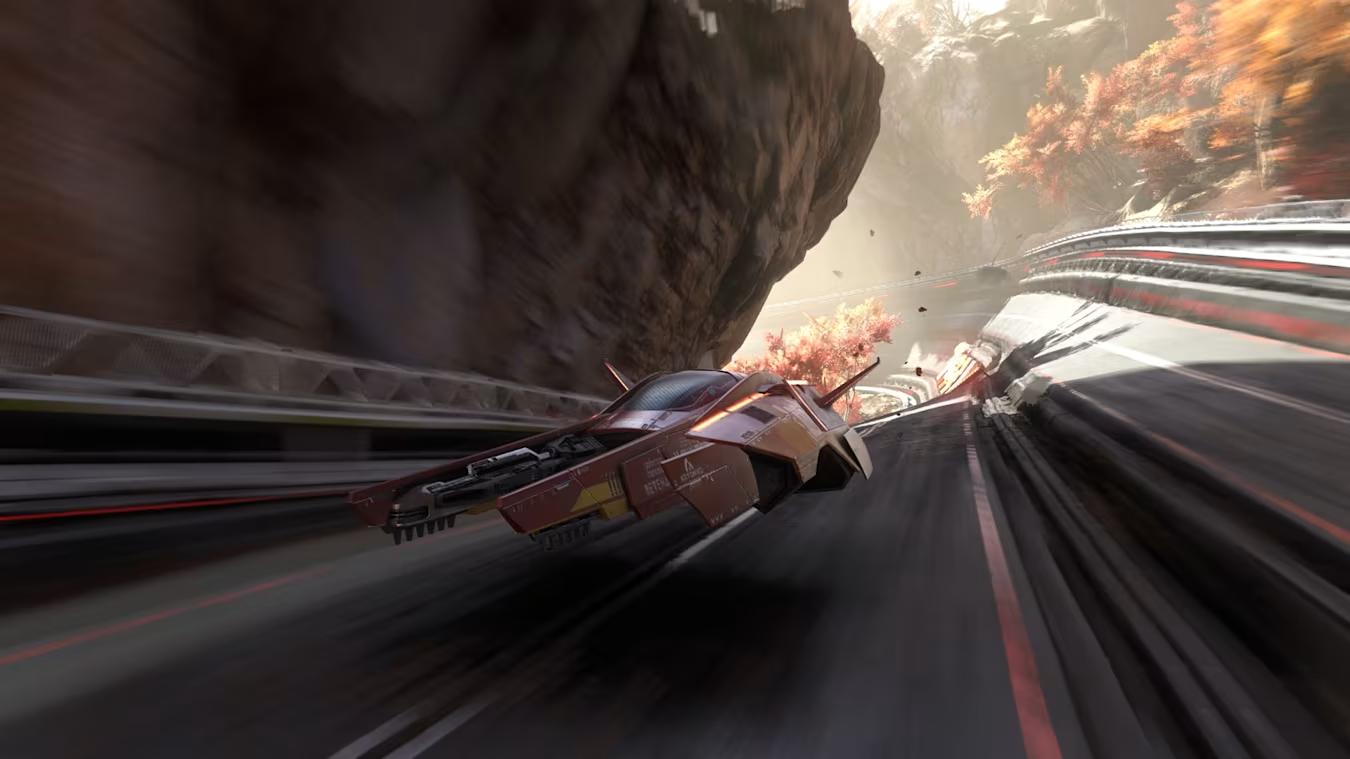
Fast Fusion, the latest racing game by Shin’en, launched on June 5 alongside the Nintendo Switch 2. As you can imagine, the small release was a bit overshadowed by Mario Kart World on day one. I had skipped it myself until a few days ago when I realized that it only costs $15, making it one of the system’s least expensive new games. I picked it up out of pure curiosity, and I’m very glad I did. If you squint your eyes, Fast Fusion is basically an F-Zero game — and a very good one at that.
Fast Fusion is the fourth game in what’s been dubbed Shin’en’s fast series, which started back on the Wii. It’s a follow up to Fast RMX, which just so happened to be a launch title for the original Nintendo Switch. Fast Fusion follows that same trajectory, acting as an indie showpiece for what the new hardware is capable of.
Like previous entries, Fast Fusion is all about speed and death-defying risks. It’s an antigravity racing game that’s very much cut from the same cloth as F-Zero GX (which, coincidentally, is also available on Nintendo Switch 2 now via its GameCube library). There are no items or tricks like drifting. Instead, races are straightforward tests of skill. Boosting is fundamental to victory, as players need to constantly manage an energy gauge that can be topped off by collecting orbs. There’s a tremendous sense of speed here that’s made possible by a stable performance mode that keeps things moving at 60 frames per second, though resolution takes a notable hit in that trade off.
The other twist is that cars have two color-coded forms, which can be flipped on the fly with a button. Doing so is crucial for taking advantage of boost strips, which will only work if the car matches its color when gliding over it. It’s a small feature, but one that means that players always need to be ready to react quickly to maximize their speed.
Fast Fusion is all about being reactive while carefully mitigating risks. For instance, I can press a button to send my car flying into the air. It’s a great trick that’s especially useful when launching off of slopes, as it can allow me to reach hidden shortcuts and alternate routes on occasionally fractured tracks. Some boost orbs are suspended in the air too, tempting me to leap up and grab them. But jumping can be dangerous too, as hitting the ground wrong or overshooting my landing by triggering an overeager boost might leave my car totaled. A skilled racer will learn how to practice restraint, gauging exactly when and how far to jump on any given track. It’s a game for people who love mastering tracks with consistent results and chopping down their best times.
As you can likely guess by its $15 price tag, Fast Fusion is a relatively small game. It features a handful of cups, time trials, and a pro mode that ends the race when your car explodes. That’s rounded out by a simple progression hook, as new cups, cars, and difficulties need to be unlocked with the cash earned from winning. It can get a little dull to grind the first few cups over and over to get more content early on, but the racing is exciting enough to make it worthwhile.
The thing that makes it worth buying, though, is that it utilizes the Switch 2’s new GameShare feature. That means that you can play it with a friend on another console even if they don’t own it. You can even get on GameChat, share it through there, and instantly start playing with someone on the other side of the country. Considering that only a handful of Nintendo games currently use the feature, Fast Fusion is the best test case for it currently.
I know that I won’t get quite as much time out of Fast Fusion as I will Mario Kart World, but it’s really scratching that F-Zero itch for me right now. I’m having a blast as I learn to master tracks, calculating exactly where I can jump from to grab a constant stream of boost orbs. I’m steadily working my way up to the pro mode as I hunt for the perfect car to suit my playstyle. Whether you’re looking for a more technical racing game or simply don’t want to spend $80 on Mario Kart, Fast Fusion is an excellent way to fill the gap until the Switch 2’s next big game.
Fast Fusion is out now on Nintendo Switch 2.
Imagine tapping a Zelda icon on your iPhone and jumping straight into Hyrule. A new open-source project called nxnative makes that possible by repackaging Switch games you’ve bought into apps for iPhone, iPad, and Mac, with no emulator in the middle.
Why does this run so well on Apple devices?
The Call of Duty franchise has held a special place in my heart ever since I played my first Black Ops game back in 2010. That game's campaign was something else, with twists and turns that culminated in a mind-blowing finale. We can all admit that compared to those older campaigns, the recent CODs have been lackluster at best, and a complete and utter disappointment at worst. The reboot of Modern Warfare did give me some hope, as the first two installments were actually quite good, but the third game left such a bad taste in my mouth that I wasn’t exactly expecting much from Modern Warfare 4.
After recently finishing the campaign, I can say that this installment is nothing like the recent releases and instead feels closer to the franchise’s roots. For the first time in a long while, the campaign comes across as well-crafted rather than rushed to hit a release date. It arrives three years after MW3, and you can see exactly where all that time went. It seems the studio finally made listening to player feedback a priority.
Epic Games has just announced the 2026 Epic AI MegaJam, which is looking to see how much game development can be squeezed into a very short window. This is running from November 12 through November 15.
Participants can work alone or in teams of up to five people, build in Unreal Engine or Unreal Editor for Fortnite, and bring along “as many AI agents as you want.” Epic explicitly encourages coding agents, AI-generated assets, audio tools, writing tools, and other AI systems. The official event page literally says "Vibe your way to $50k.”