
“Why you can trust Digital Trends – We have a 20-year history of testing, reviewing, and rating products, services and apps to help you make a sound buying decision. Find out more about how we test and score products.“
The first thing to know about Metal Gear Rising: Revengenace (I find that when saying the name it helps to shout “Revengenace!” for emphasis), is that it is not a Metal Gear game. It features everyone’s fourth or fifth favorite character of the Metal Gear franchise, Raiden, but it does not continue the sprawling and convoluted musings of Hideo Kojima. There is no deep philosophical analysis of the nature of war. Instead you have a cyborg with a sword that cuts people so hard they explode.
The only people that should really take umbrage to this are the hardcore Metal Gear fans that are lost in the story. Despite the promise of seeing Raiden evolve (or perhaps devolve) into a full cyborg, the story barely addresses this. It is a spin-off story in the Metal Gear franchise, not a partial prequel to Metal Gear Solid 4.
This isn’t a criticism, mind you, just a disclaimer. Revengenace could easily remove all traces of Metal Gear and lose nothing in either the story nor action. A bit of Raiden’s backstory does come into play, but only barely, and never in a way of any real consequence to the series.
In place of the stealth action that made the Metal Gear name so renowned is a hack-and-slash action game that revels in its over-the-top action. If Congress were to see just snippets of this game taken out of context, minds would be blown. You cut, slice, and maim your way through the adventure, leaving bloody bits of former enemies in your wake, but that is just the cosmetic trappings adorning an otherwise memorable combat system that stands out from a somewhat generic game.
Although the story isn’t directly related to the Metal-Gear narrative, either in direct story or even in themes, it does share a bit of Kojima’s more insane side. By the time Revengenace begins, Raiden is already a cyborg – albeit not that great of one. After one of his missions goes badly, he gets an upgrade in order to seek revenge(ance). This leads him down a rabbit hole involving private military companies, a plot to overthrow the United States, and a chance meeting with a robotic dog who becomes his BFF following a bit of reprogramming.
The story is very much secondary to the gameplay, although there are times when Revengenace seems almost unaware of this. It never comes anywhere near the ridiculously lengthy cut scenes made famous (or perhaps infamous) by other Metal Gear games. But they do drag on a bit, especially when they steep themselves in melodrama.
For the most part, the game’s story does not take itself seriously. Far from it. There are even moments where it makes fun of its own heritage, and introduces loud, bombastic characters that are the antithesis of the often thoughtful opponents more typical of Metal Gear. – although they are equally weird.
Revengenace is the video-game equivalent of a grindhouse movie: The plot does what it needs to do and helps to set the tone. It is unrepentant in what it is, from the incredibly cheesy dialogue delivered badly to the blood and gore, which is actually not that gory when you look closely at it.
Even the music is made for a very particular type of gamer, setting the mood of the game throughout. From the start you are assaulted with J-rock, as the best of Japanese video game studio rock unleashes audio devastation that is equal parts perplexing and infectious. Listening to it in any other context would be silly, but it fits this game like a glove.
The big draw of the game is the gameplay, of course. You are a cyborg with a sword, what else could it rely on? Platinum Games makes a very particular type of game; focusing on the gameplay before anything. Sometimes this comes at the cost of other things, but it is a deliberate style choice. If you have played other Platinum Games like Vanquish, or even Bionic Domain to a degree, then you will have a good idea of the type of game Revengenace is going in. Each game adopts a different style, but there is a similar feel to their approach – a sort of balls to the wall, casual disregard for any semblance of realism.
 As Raiden, you are equipped with a sword as your primary weapon. Throughout the game, you will earn additional weapons that you can use to replace your strong attack. You also have the odd secondary weapon like a rocket launcher or stinger missile (or the odd box to equip), but the majority of the game is spent with your trusty sword in hand.
The method of attack is traditional hack n’ slash, with two attacks: light and strong. One thing that sets Revengenace apart though, is the “Blade Mode.” When your gauge is full, you simply hold down the left trigger/L2 button, and you freeze in place while the world around you slows down. Using the analog sticks or the face buttons, you can then begin cutting on most things standing in front of you until they are in little, tiny pieces. This attack is effective on things like tanks, but mostly it is used to defeat enemies and leave them in bloody chunks. While there is a touch of the grotesque to this, the blood and gore could be much worse. The enemies usually fall in neat chunks then disappear. Occasionally they will explode, bizarrely.
You can also use the “ninja run,” an ability that allows you to scale some walls and deflect gunfire, but it is meant to be used in motion, not in a true combat encounter. If you choose to try stealth your way through a section, this agility-based move is your best bet.
This method of slicing and dicing, known as ZanDatsu, is most effective against tougher enemies that you have already worn down. When they turn blue, you can then cut through that highlighted section, be it the legs on a mechanized gecko from MGS4, or an opposing troop. If you time your attack correctly, you can also find a weak point signified by a box, that cutting through gives you the prompt to steal their power cells and refill your gauge.
 The other thing that truly sets the game apart is the block and counter system. Rather than having a dedicated button to block, you need to push forward into an attack. If you hold it forward, you will just block, but if you time it so you press forward and attack at exactly the right moment, you will deliver a powerful counterattack.
Getting comfortable with this system is what will make the difference between having a good time with this game or a frustrating one. When you are in a rhythm, countering a group of enemies and moving between them is a smooth and fluid ballet of violence. When you don’t, as often happens when the screen gets too crowded and you can’t see where attacks are coming from, Revengenace falters.
There may be a steep learning curve for some, but once it clicks, the combat system is dynamic. It also helps to earn and unlock upgrades that expand your repertoire, and trying out the additional weapons you earn keeps things fresh. The pacing is also very good, as the game introduces things at a speed that allows you to learn without realizing how much you are improving – right up until the incredibly frustrating final boss fight that seems to contradict everything you have just learned.
While the combat is the highlight of Revengenace it can’t help to hide some of the game’s shortcomings. For one, it is short – and not just in length, but content. The campaign can be completed easily in five or six hours. While the optional VR Missions do help pad the offering, and there is replay value as you try to unlock everything, the game boils down to you running from room to room and fighting similar looking enemies again and again.
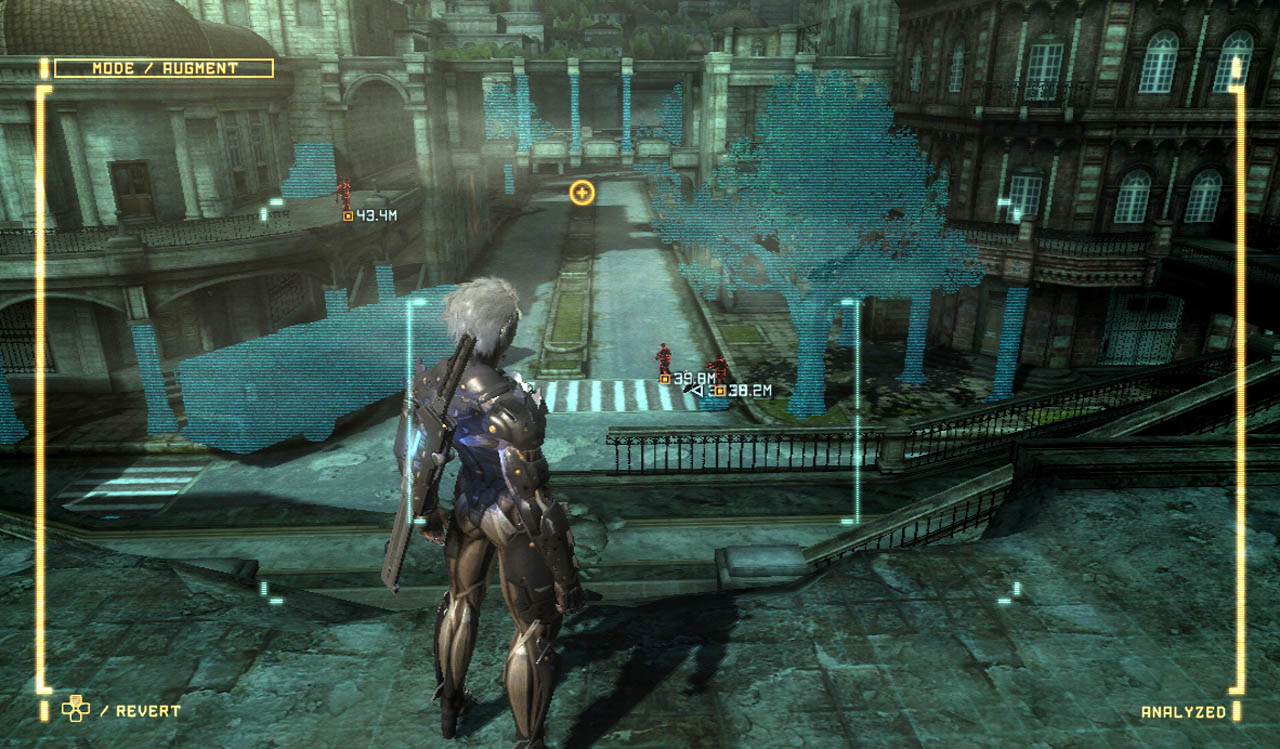 This stands out a bit more due to the often bland level design and average graphics. Sewers, military bases, and warehouses feel much like city streets. There are also plenty of missed opportunities everywhere. The Blade Mode that allows you to cut through most things is impressive, but beyond slicing up enemies and decimating the odd car that looked at you funny, it is rarely used for anything more creative. A few instances where you need to cut things out of the air show the potential that it never lives up to.
There is a slightly generic and bland feel throughout the game that is apparent when the “cut through anything!” mantra proves false, and a rickety wooden door that you aren’t supposed to go through proves invincible. It’s necessary, of course, but it reinforces the sense that this game plays it very safe and rarely offers up anything that you haven’t seen before – even with the few unique tricks up its sleeve.
If you are a fan of hack and slash games, then ignore the score and dive in. The combat mechanics are solid and the ability to cut enemies into – literally hundreds if not thousands – of tiny pieces never, ever gets old. Once you learn the counter system, fighting your way through a large group is electric.
In most other ways though, Revengenace is a very average game, with mediocre level art and a story that requires you to look at it through a specific lens. Becoming a cyborg would likely be a somewhat horrifying experience as your old body was cut away bit by bit, but instead it is seen as if through the eyes of a kid that thinks it’s “bitchin’.” Don’t take that as a negative, just as an example of the mentality at work in the story. It isn’t deep, but it is flashy.
“Revengenace!” deserves to be yelled, because that is what the game itself does. It yells at your senses and assaults you with a fast-paced action game that rarely slows down, because when it does you can see the rough edges.
(This game was reviewed on both the PS3 and the Xbox 360 thanks to copies provided by the publisher)
Imagine tapping a Zelda icon on your iPhone and jumping straight into Hyrule. A new open-source project called nxnative makes that possible by repackaging Switch games you’ve bought into apps for iPhone, iPad, and Mac, with no emulator in the middle.
Why does this run so well on Apple devices?
The Call of Duty franchise has held a special place in my heart ever since I played my first Black Ops game back in 2010. That game's campaign was something else, with twists and turns that culminated in a mind-blowing finale. We can all admit that compared to those older campaigns, the recent CODs have been lackluster at best, and a complete and utter disappointment at worst. The reboot of Modern Warfare did give me some hope, as the first two installments were actually quite good, but the third game left such a bad taste in my mouth that I wasn’t exactly expecting much from Modern Warfare 4.
After recently finishing the campaign, I can say that this installment is nothing like the recent releases and instead feels closer to the franchise’s roots. For the first time in a long while, the campaign comes across as well-crafted rather than rushed to hit a release date. It arrives three years after MW3, and you can see exactly where all that time went. It seems the studio finally made listening to player feedback a priority.
Epic Games has just announced the 2026 Epic AI MegaJam, which is looking to see how much game development can be squeezed into a very short window. This is running from November 12 through November 15.
Participants can work alone or in teams of up to five people, build in Unreal Engine or Unreal Editor for Fortnite, and bring along “as many AI agents as you want.” Epic explicitly encourages coding agents, AI-generated assets, audio tools, writing tools, and other AI systems. The official event page literally says "Vibe your way to $50k.”