
 Tomb Raider players, much like the freshly de-aged Lara Croft, face a bit of a learning curve as they step into Crystal Dynamics’ brave, rebooted world this week. It’s not that the series reboot is impossibly challenging; it’s just a very different beast. Tomb raiding shifts to a secondary concern – it’s essentially for collectibles now – and the focus is instead on puzzle-solving by way of environmental traversal and combat. Lots and lots of combat.
The result is a game that flows somewhat differently than its predecessors. Yamatai Island isn’t quite a fully open world; it’s more like a Zelda game, with a series of hubs that offer an increasing number of locations to access as you add new items to Lara’s toolbox. Along with the adjusted pace of things is a new-to-the-series multiplayer mode that carries many of the campaign’s fresh wrinkles into the context of adversarial third-person action. This little primer is meant to introduce you to both sides of the game so you can go in at least a bit more prepared than Lara does….
Lara is in a pretty lousy situation when she first sets out on her Yamatai adventure. She’s been pierced in the midsection by an unfortunately placed bit of rebar and she’s got nothing in the way of survival gear. That changes quickly enough as you follow the critical path quests, an easy thing to do in the early going before the world really opens up.
 One of the most useful tools that you have in the game is Lara’s Survival Instinct. Tap LB/L1 to drape the screen in a black and white overlay that highlights mission critical checkpoints, objects of interest, animals, and the like. Some of this stuff only appears after you’ve unlocked the appropriate ability upgrade, which is something we’ll get to in a little bit. The key thing to understand about Survival Instinct is that it remains active for as long as you stand still. It disappears as soon as you move, but you are free to stop completely and pan the camera around at your leisure in search of items of interest.
 Ammo is abundant throughout the game, so don’t be afraid to use all of your arrows hunting animals in the early going. You can’t actually hunt in an area indefinitely; a message pops up letting you know when it’s time to move on after you’ve preyed on enough wildlife. Farm every one of the opening areas for an added XP boost in the early going; be sure to walk over to each kill and skin it for the full reward. As you level up, invest early in all of Lara’s survival skills. This not only improves your Survival Instinct, it also allows you to earn bigger XP and salvage (Tomb Raider‘s currency) rewards from your kills, human and animal alike.
 The animal hunting and the XP rewards you reap from it becomes less important once you’re out of the introductory segment. Survival Instinct continues to be valuable though, especially once you unlock the ability to have collectibles highlighted, even through walls. Gathering things like GPS caches, treasures, and lost journals always brings an XP boost of some kind. The same goes for hunting down and solving the puzzles in optional hidden tombs. Take a little extra time to search each new area; you won’t be able to grab everything in most cases, not until you unlock later tools and upgrades, but every little bit of bonus XP helps.
Get in the habit of keeping an eye out for burning bonfires. These are your Base Camps; each hub typically has a few of these, and you can interact with any of them to access the skill upgrade and weapon upgrade menus. Base Camps also double as a sort of collectible, with the game tracking how many you’ve found in each area. Make a beeline for the nearest Camp whenever you collected the last in a series of weapon-specific upgrades – these are random drops. Once you have three of them, you can level up the associated killing tool by simply sitting down at the fire and opening the upgrade menu. Parts purchased for each weapon carry over into future upgrades, so don’t be afraid to spend freely.
 Many – but not all – Base Camps also offer the ability to fast travel. You can access the associated menu once you sit down and easily zap yourself back to any previously visited Base Camp. You have to sit down at one in order to unlock it for fast travel though, so even if you don’t have any skills or upgrades coming your way, make sure to plop down for at least a second in front of every bonfire you come across.
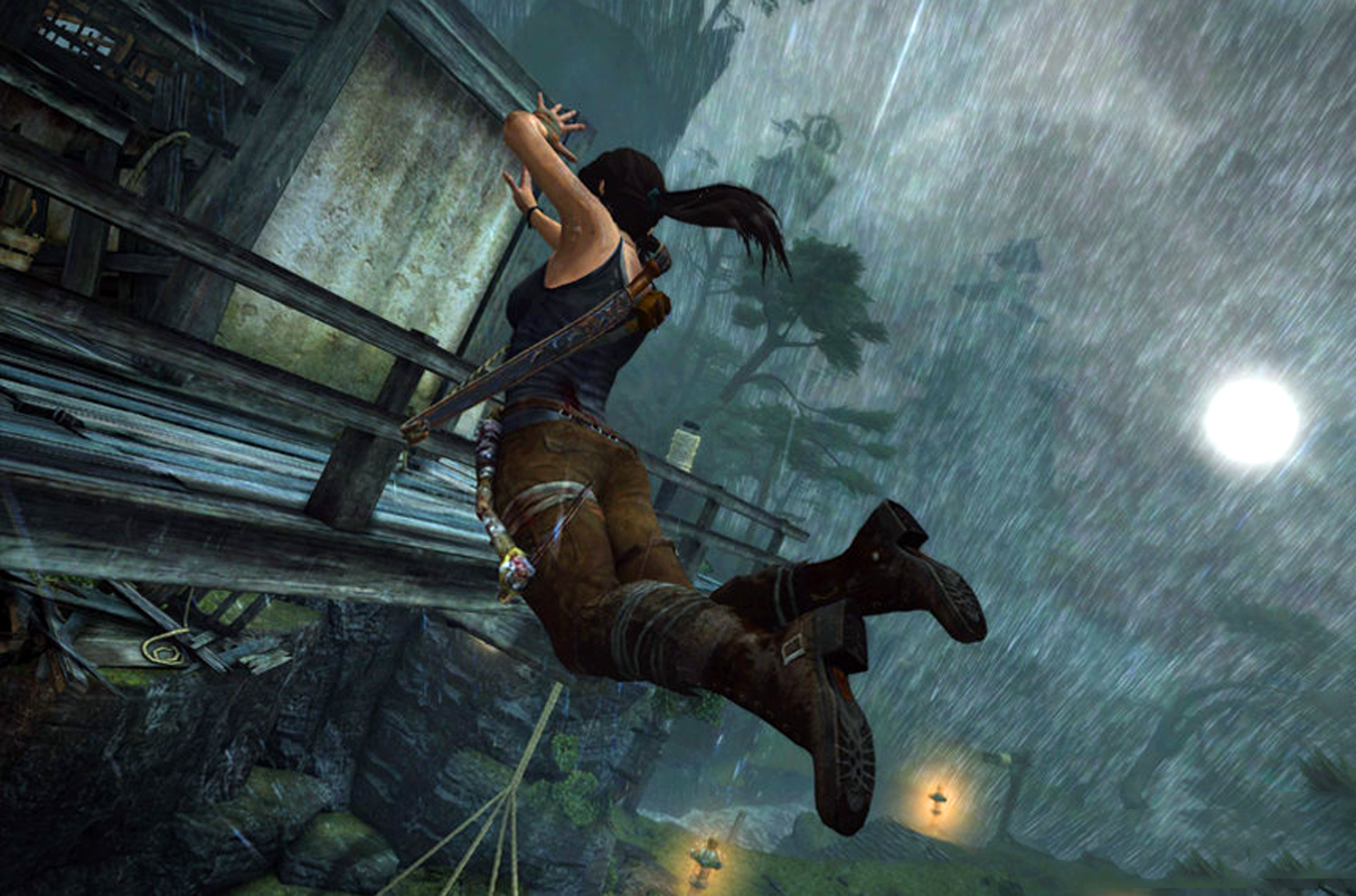 Longtime fans of the Tomb Raider series are in for a bit of a shock on the action side of this reboot. Not only is there a whole lot more combat (a whole lot more), but the pacing of it is also fundamentally changed. In short: auto-aim is a thing of the past. Now you’ll have to manually aim, either firing from the hip or aiming down the sights for more accuracy, just like you’d expect from any other present-day third-person action game.
The good news is, weapon handling in Tomb Raider feels great. There’s an immediate feeling of feedback as you go from trigger pull to firing animation to damaging an enemy. It’s similar in feel to the Uncharted series, but the combination of Lara’s hardiness and smoother weapon handling result in much more entertaining play. Once you go loud, combat becomes very tactical. Enemy AI is intelligent enough to flank and rush your position using appropriate forces. Strategic retreats are frequent, and Lara’s traversal skills come in particularly handy here.
There are, however, many situations in which going loud is purely optional. Lara is a sneaky lady, and she’ll automatically duck down to hide herself behind any nearby cover if that’s an option. Early on, her bow is your most effective tool for silently taking down the enemy. Always aim for the head, though note that you do also inflict more damage when firing undetected. Just be careful with notching arrows; keep the drawstring pulled back for too long, and Lara’s aim starts to wobble. Eventually, she loses the shot entirely.
 There’s no real trick to combat, beyond nailing down a basic understanding of how smart your foes are and what sort of opposition they’re throwing your way. A much wider variety pops up as the story unfolds, with enemies eventually putting on body armor and bringing riot shields out. With melee attackers, Lara’s dodge move is essential. Tap the button and then tap it a second time just before she starts to stand back up and you’ll perform a combat roll. Shield-carrying enemies must be dodged; as soon as you come back up, fire indiscriminately in their direction while their guard is momentarily down; if you’re quick enough, you can typically bring them down after one dodge.
 Online Tomb Raider plays almost identically to campaign Tomb Raider in terms of your basic controls. There are some differentiating factors that set the warring scavenger and survivor factions apart in the early going, but leveling up offsets these differences. It largely boils down to starting weapons. Survivors have an SMG and shotgun early on, whereas scavengers have an assault rifle and rudimentary bow. A few matches should be more than enough to level you to the point that you can equip almost any type of weapon for either faction.
There are a few additional elements to player loadouts beyond the weapons: Your custom classes are faction-specific, as you’ve probably guessed already. Two upgrades can be applied to each weapon; one for projectiles and one for attachments, and you’ve got a selection of three in each category. On the projectile side, going with the damage boost is generally your best bet. The attachments are a bit more weapon-specific, so just go with whatever suits your playstyle. Note, however, that owning an upgrade for one weapon doesn’t mean you own it for all weapons. You’ll have to purchase them every time you unlock a new firearm.
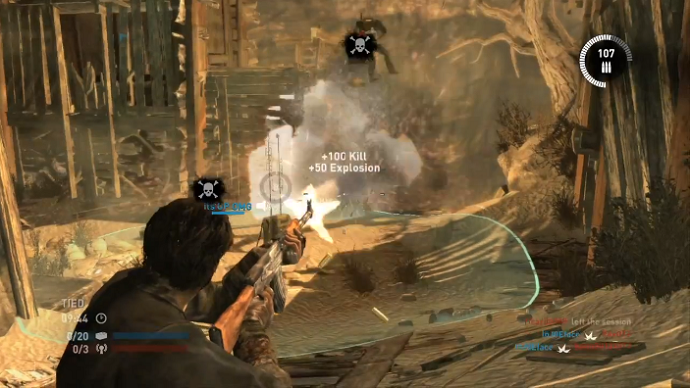 You also have the option of equipping Perk-like Offensive and Survival skills. Once again, this is very straightforward stuff and should make immediate sense to anyone who has ever played a progression-driven multiplayer shooter. The XP booster Offensive skill is invaluable in the early going. For Survival skills, go with anything that reduces the damage you take. Bulletproof is a favorite, though you’ll have to climb through the ranks a bit before you can equip it. Loadouts also include an explosives category; go with frag over incendiary and explosive traps over throwables. The scavengers’ dummy ammo crate is particularly useful.
 All of the leveled-up traversal abilities from the campaign carry over to multiplayer, so you can use your axe to climb up stretches of rock and your rope ascender to… uh… ascend rope. Quickly. Keep an eye out for explosive barrels. Not only are they devastatingly effective against nearby enemies, they can also be used re-shape the environment. Also watch for traps, either ones you can set (a button prompt will appear) or ones that will stop/kill you.
The really cool thing to keep in mind about Tomb Raider‘s multiplayer is that rewards are given for just about everything, even failure. Just being on the losing team nets you a 1,500 XP bonus. Setting traps, being trapped, blowing things up, using turrets, and even being killed multiple times by the same opposing team member all net you bonus XP in varying amounts. So don’t let losing get you down; keep playing, and you’ll get the good stuff regardless of whether or not you’re kicking ass.
Remember when transparent gadgets were the coolest things you could own? Sony is bringing that late '90s aesthetic back with its new PS5 Prism Collection. The gorgeous lineup gives your DualSense controller and PS5 console a glossy, see-through makeover in three eye-catching colors.
https://twitter.com/PlayStation/status/2115459064981512662?s=19
For years, Call of Duty’s campaign mode has used big, scripted set pieces to tell the overarching story amid all the adrenaline-pumping action. The 2023 Modern Warfare 3 tried to shake up the established formula by introducing a handful of short open combat missions, and I genuinely liked the idea, but the game's overall negative reception seeped into how those missions were received.
I feared the next iteration might abandon the idea because of the backlash, but I am glad it didn't. MW4’s “Stranded” mission uses the same approach, but instead of fragmenting it across the campaign, it puts it all in a single large-scale open-world mission.
Acer’s Predator Atlas 8 finally has a US release date and price, several months after the company first showed off the handheld in May. The highlight is the Intel Arc G3 Extreme chip inside, which has been adopted by only a couple of other consoles besides the Atlas 8. This version will go on sale exclusively at Best Buy on November 1 for $1,299.99.
Acer originally said the Atlas 8 would arrive in North America in October, but left pricing open at the time. The launch came amid the ongoing DRAM crunch, which has made memory more expensive across the PC industry and complicated pricing for hardware makers.