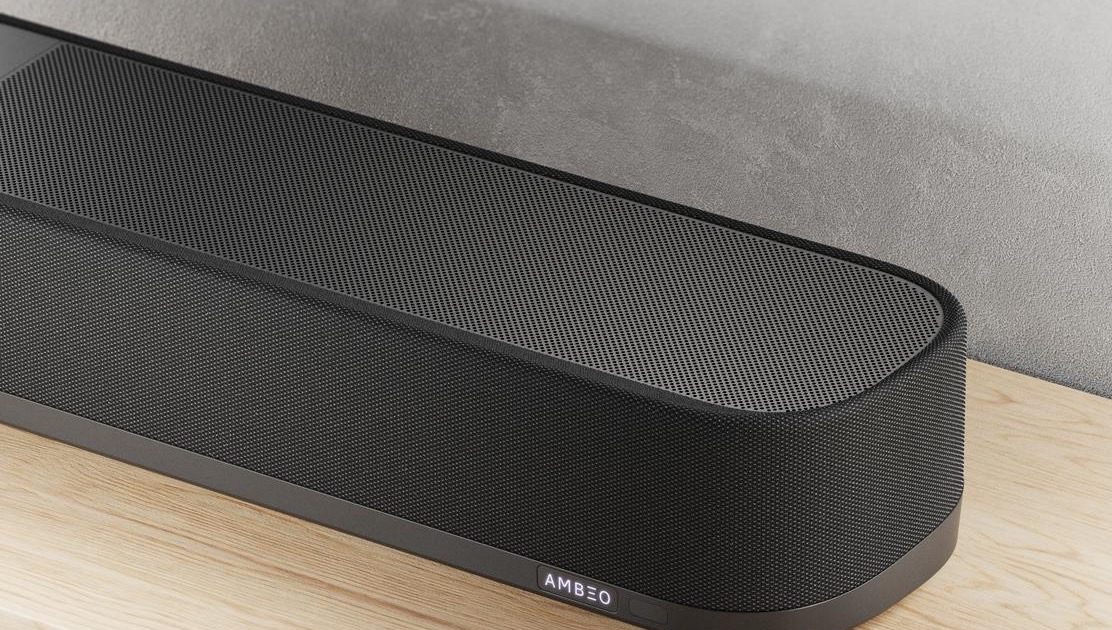
Sennheiser’s Ambeo soundbar has pretty much dominated any list of the best soundbars since it debuted, thanks to its incredible performance as a one-stop-shop for Dolby Atmos home theater sound as well as its impressive musical chops. But the Ambeo is really expensive ($2,500) and really, really big (you can’t place it in front of a normal TV without obscuring a significant chunk of the bottom of the screen).
But starting September 1, those two challenges have been addressed: There’s a smaller and more affordable Ambeo soundbar in town, the $1,500 . Both products can be pre-ordered right now and will begin shipping on September 22.
The Ambeo Soundbar Plus is considerably smaller than its bigger brother, which Sennheiser has chosen to rebrand as the Ambeo Soundbar Max. The company hasn’t released official measurements, but one look at the photos and it’s plain to see that the Plus is about half the height, and a good bit narrower than the Max, making it far more likely to find a home in front of most TVs.
Despite its smaller stature, Sennheiser claims it will still deliver a standout audio performance. The company says it’s the first single-speaker soundbar capable of delivering 7.1.4-channel sound. Technically, that’s true, but it won’t be the only soundbar with that claim for long — Bang & Olufsen’s recently announced Beosound Theatre, which is coming in October, can do that too, but admittedly at a cost that makes the Ambeo Soundbar Max look like a bargain.
The Soundbar Plus achieves that multi-channel magic via nine drivers that aim sound forward, upward, and to both sides. They’re controlled by the same 3D sound algorithms that Sennheiser developed in conjunction with the Fraunhofer-Institute for Integrated Circuits IIS for use in the Ambeo Soundbar Max. There’s also an automatic room calibration feature, and when everything is working as it should, Sennheiser says the system can position seven virtual speakers around the listener, plus four more overhead.
From a connectivity point of view, the Soundbar Plus looks well-equipped, with two HDMI 2.0a inputs, an HDMI 2.1 ARC/eARC output, an optical port, stereo RCA analog input jacks, an Ethernet jack, and a USB port that is only used to power accessories. Sennheiser tells Digital Trends that the HDMI inputs can passthrough 4K resolution with Dolby Vision. But with HDMI 2.0a, the Soundbar Plus might not be the best conduit for console or PC gamers looking for fast, 120Hz support.
On a wireless level, there’s built-in support for Apple AirPlay 2, Chromecast built-in, Spotify Connect, and Tidal Connect, and it works with Siri, Google Assistant, and Amazon Alexa. All of that is embedded in the Ambeo OS software that lets you control the soundbar via a mobile app if you choose. Inside the app is a customizable EQ with presets, something that has been notably absent on premium soundbars from Sony, Bose, LG, and others.
In addition to the expected Dolby Atmos support, the Plus can also handle DTS:X, Sony’s 360 Reality Audio (360RA), and MPEG-H Audio. With Bluetooth 5.0, the soundbar also supports AAC and SBC codecs. Curiously, if you dive into the specs, you’ll see support for the LC3 codec, which belongs to LE Audio, a feature of Bluetooth 5.2, not 5.0. Sennheiser says it uses this LE Audio connection strictly for wireless communication when the Ambeo Soundar Plus is paired with an Ambeo Sub, and not for music streaming.
The Ambeo Sub is also techno-loaded, with its own built-in microphone for self-calibration. It’s wireless and can also be controlled independently via the same Smart Control app.
There’s an 8-inch woofer inside the cabinet, and it’s powered by a 350-watt class-D amp, and Sennheiser says it can drive frequencies as low as 27Hz. You can also run as many as four of these beasts simultaneously, with each unit appropriately calibrated for your specific room layout.
Related Posts
I desperately want a new classic Walkman, but Sony probably can’t give me one

All of this makes it the perfect time for Sony to bring back the classic Walkman, which was a phenomenon during the 80s and 90s. I would love one. Give me a compact cassette player, physical buttons, and wired headphones. Keep the apps, notifications, and algorithms that shape your taste of music. No more AI assistants or personalzied feeds, just you and your Walkman. There is only one problem though. Recreating the Walkman that people love and remember, would be far harder than putting an old design back into production.
Proton reveals how smart TVs track you and the escape situation is pretty grim

The worrying part is that escaping this tracking is becoming increasingly difficult because many privacy controls are buried deep in settings or enabled by default. Proton argues that buying a smart TV today often means accepting a level of surveillance that most people never knowingly signed up for.
LG is cracking down on smart TV apps that quietly turn your TV into a secret proxy
The move follows a report from security firm Spur, which found that more than 42 percent of apps on LG's webOS store include SDKs that quietly reroute internet traffic through your TV, indefinitely. Samsung isn't spared either, with over a quarter of Tizen apps carrying similar code.