Robert De Niro’s ninth Oscar nomination as an actor, for Killers of the Flower Moon, is only the latest of the triumphs and accolades that have been showered upon this storied actor over the course of his career.
Long-term collaborations with several of the greatest directors of the past 50 years have led to a transition into producing and an unimpeachable industry legend status. Here are the seven greatest Robert De Niro films, ranked from the very good to the very best.
An utterly prescient tale of “fake news” made at the nascence of the 24-hour media cycle, director Barry Levinson’s Wag the Dog gives De Niro the classic strong-but-silent character he does so well.
De Niro’s political consultant Conrad Brean is charged with creating, through media manipulation, a phony war in Albania to distract the public from a presidential sex scandal. As with so many other classic De Niro characters, he’s part of a study in contrasts, and perfectly paired with Dustin Hoffman’s off-the-wall Hollywood producer, called in to story-edit the conflict.
The highlight of De Niro’s famously uneven 21st century filmography, David O. Russell’s romantic dramedy proved the then-near-septuagenarian De Niro could hold his own with young guns like Jennifer Lawrence and Bradley Cooper, off whom he plays beautifully.
Genuinely well-written comedic roles have come De Niro’s way precious little, and this one is a blast, as he plays an older man set in his ways whose superstitions and paranoia have come to be so much a part of his life that they have infected his family at large.
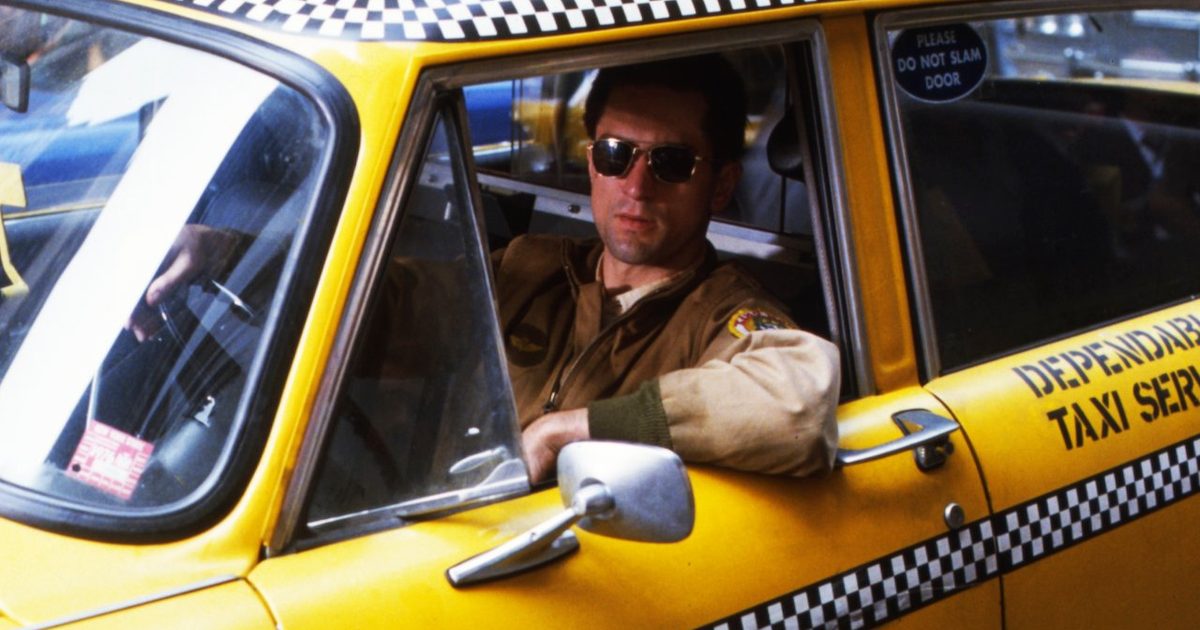
De Niro drove a New York City cab for weeks as preparation for his breakout role as psychopathic wannabe assassin Travis Bickle.
The manic facets of De Niro’s performance are legion, but less discussed are those elements of Bickle that are genuinely tender – if pathetic – including his wooing of political operative Betsy (Cybill Shepherd). In these scenes, the impossibility of Bickle, a Vietnam vet, ever successfully reintegrating into society becomes clear.
In The Godfather Part II, De Niro and Al Pacino played characters in different timelines, dancing around one another, but by definition unable to interact. The promise of that film came to its fruition two decades later with Michael Mann’s cops-and-robbers masterwork Heat. In the film, De Niro’s Neil McCauley (based on a real criminal of the same name) cunningly evades Pacino’s dogged cop, Vincent Hanna.
The scene in Heat when McCauley and Hanna finally meet displays Mann’s keen understanding of the audience’s reading actors’ real-life dynamics into their characters. The sequence, referred to in film circles simply as “the diner scene,” is foreshadowed and teased with utmost care until it finally unfolds in an as-promised clash of dramatic titans.
It’s nearly impossible not to love Goodfellas, Martin Scorsese’s freewheeling mob panorama, and De Niro’s supporting performance is a big reason why.
As Jimmy Conway, mentor to Ray Liotta’s Henry Hill, De Niro is the charming but deadly mafia operative who always has things under control – until he doesn’t. His coy smiles and raspy laughs give way to bursts of violence when he can’t have what he wants.
In his second Academy Award-winning performance after The Godfather Part II, De Niro delivers a master class in physicality. As boxer Jake LaMotta, his quintessential characteristic is his brutishness, but that quality takes on different sheens over the film’s timeline, as he goes from agile, determined fury as a young man to an older man drowning in his own flesh and the memories of his past.
Throughout, De Niro’s LaMotta is a man inescapably weighed down by his own body, with its lusts and capacities, simultaneously his best friend and worst enemy.
Francis Ford Coppola’s epic, a sweeping survey of the immigrant experience in America that justifies the oft-used cliché “every frame a painting,” is anchored, yes, by the continuation of Al Pacino’s masterful three-film arc as mafia boss Michael Corleone. But as the younger version of his father, Vito, De Niro contextualizes Marlon Brando’s superb performance in the same role in the previous film, making Vito into a coiled viper topped with pomade, with the cruelty of his past manifesting as controlled rage.
The Godfather Part II remains one of the only films to have made really effective use of De Niro’s famed silence and reserve – Vito playing his cards close to the vest is what gives him his power, just as De Niro’s subtlety is what gives him his.
Related Posts
You can now enjoy Substack on a TV, if that’s your idea of fun times

The app, which has just rolled out for Apple TV and Google TV, basically takes the video content and livestreams from the creators you already subscribe to and splashes them onto the biggest screen in your house. It is a smart, calculated move toward what the tech industry calls a "lean-back" experience. Instead of hunching over a laptop or squinting at a smartphone screen to watch a forty-minute interview or a deep-dive lecture, you can now throw it on the TV while you cook dinner, fold laundry, or just relax on the couch.
Wondering if YouTube TV is worth it? This new promo will help you decide without hurting your wallet

Typically, YouTube TV offers a 7-day free trial, after which subscribers pay $82.99 per month for the streaming service. Under the new promotion, subscribers can enjoy a 10-day free trial and pay just $59.99 per month for the first two months.
Netflix’s latest move is huge for movie theaters, and fantastic for you and I

In April 2025, Sarandos previously stated that he loved theaters but thought that theatrical moviegoing is an “outmoded idea, for most people, not for everybody.” As a result, Netflix's purchase of Warner Bros. ignited backlash and fears over the film industry's future.