Invisible threat disrupts NASA’s first Mars mission in 5 years
|
By
Trevor Mogg Published November 12, 2025 |

While it’s fairly common for inclement Earth weather to delay rocket launches, it’s very rare for space weather to do the same. But’s that’s exactly what’s just happened.
Blue Origin had planned to launch its two ESCAPADE spacecraft to Mars from Cape Canaveral in Florida on Wednesday following a scrubbed attempt on Sunday, which, incidentally, was down to Earth weather.
But on Wednesday, Blue Origin said that while it’s rocket was ready to lift off, it had decided out of an abundance of caution to hold the launch “due to highly elevated solar activity and its potential effects on the ESCAPADE spacecraft.”
It’s now waiting for the space weather conditions to improve, which could take several days.
The disruption is down to extreme activity on the sun in recent days involving not one but two coronal mass ejections (CMEs) in the direction of Earth. A CME is a huge burst of hot, charged plasma and magnetic fields ejected from the sun’s outer atmosphere into space. The eruption can large amounts of solar material flying outward at high speed, sometimes impacting Earth and in severe cases causing disruption to communication satellites, power grids, navigation systems, and other technologies that rely on Earth’s magnetic environment.
The geomagnetic storm currently impacting Earth is described as a “cannibal” solar storm because one faster eruption caught up with an earlier one, intensifying its effects.
The storm has produced spectacular auroras visible as far south as Alabama — a real rarity — and prompted the National Oceanic and Atmospheric Administration (NOAA) to issue a G4 (severe) geomagnetic storm watch.
The effects of this latest solar storm on critical infrastructure have yet to be fully established.
These faraway celestial events can heat and expand Earth’s upper atmosphere, increasing atmospheric drag on low-Earth orbit satellites. Indeed, three years ago, around 40 just-launched Starlink satellites burned up in Earth’s atmosphere due to increased atmospheric drag caused by a solar storm.
With that in mind, it’s perfectly understandable that Blue Origin and NASA have paused the ESCAPADE launch.
Related Posts
Space is becoming Bezos and Musk’s next data center site, and we have every reason to worry
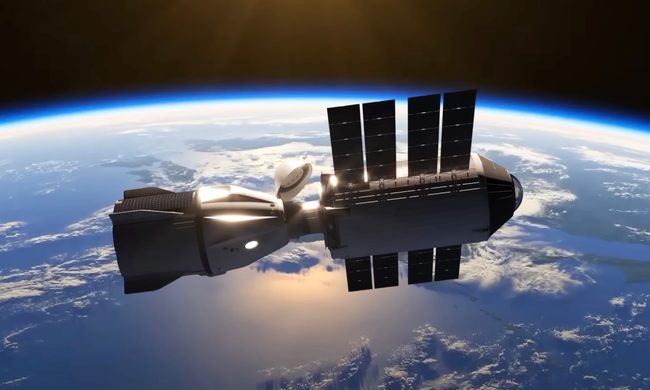
Elon Musk's SpaceX and Jeff Bezos' Blue Origin, along with several other companies, have proposed enormous constellations of satellites designed to operate as orbital data centers. However, environmental groups and former space officials are now warning that putting them into orbit at the proposed scale could have severe consequences for Earth's atmosphere and the night sky.
The first possible exomoon is here, and it makes our Moon look hilariously tiny
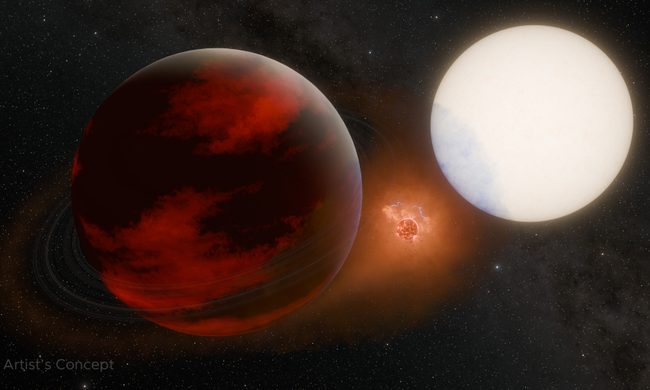
Using the European Southern Observatory’s Very Large Telescope in Chile, researchers detected strong evidence for a moon-like object in the CD-35 2722 system. Further observations are still necessary to confirm the discovery, but it could become the first confidently detected natural satellite outside our solar system. There is still one tiny complication though. This moon is apparently massive.
China’s answer to SpaceX’s reusable rockets literally catches boosters in a net

China just managed to pull off something similar, but in a slightly different way, and on July 10, it tested the method as well.