This planet is crumbling apart, giving it a giant tail like a comet
|
By
Georgina Torbet Published April 25, 2025 |

Astronomers from the Massachusetts Institute of Technology (MIT) have made an unusual discovery, finding a planet which is in the process of disintegrating. And as it decays, it is leaving behind a tail of matter like a comet.
The planet BD+05 4868 A is located 140 light-years away, and is around the mass of Mercury. Unlike Mercury, though, this planet orbits in such a tight orbit around its host star that a year there lasts just over 30 hours. Being that close to the star means that the temperatures there would be epic, at almost 3,000 degrees Fahrenheit, with the planet covered in magma which is boiling away into space.
As the planet orbits, material from its surface is being stripped away and evaporating, creating a huge tail of debris behind it — similar to what happens to comets when they come close to the sun.
“The extent of the tail is gargantuan, stretching up to 9 million kilometers long, or roughly half of the planet’s entire orbit,” said lead researcher Marc Hon of MIT. “We weren’t looking for this kind of planet. We were doing the typical planet vetting, and I happened to spot this signal that appeared very unusual.”
This long tail is what drew the researchers’ attention, as it created a distinctive signal when it passed in front of its host star. This is one common way that astronomers detect exoplanets, as they look for slight dips in the brightness of a star when a planet passes in front — called a transit. In this case, the transit seemed to last for an unusually long time, and was slightly different on each orbit — suggesting that the shape of the planet must be a little different each time. And that implied a tail.
“The shape of the transit is typical of a comet with a long tail,” Hon explained. “Except that it’s unlikely that this tail contains volatile gases and ice as expected from a real comet — these would not survive long at such close proximity to the host star. Mineral grains evaporated from the planetary surface, however, can linger long enough to present such a distinctive tail.”
The reason this particular planet is producing a tail is that it has a relatively low mass, so it has weak gravity and can more easily lose material from its surface. It is one of only four disintegrating planets ever discovered, and it is the closest of these to the Earth, so researchers want to study it in more depth with the James Webb Space Telescope.
They will have to be quick though, as the planet is being ripped to pieces and won’t last for ever. The more material the planet loses, the weaker its gravity becomes, making it lose material even faster. It’s a “runaway process,” said fellow researcher Avi Shporer.
“We got lucky with catching it exactly when it’s really going away,” Shporer said. “It’s like on its last breath.”
The research is published in the Astrophysical Journal Letters.
Related Posts
Space is becoming Bezos and Musk’s next data center site, and we have every reason to worry
Elon Musk's SpaceX and Jeff Bezos' Blue Origin, along with several other companies, have proposed enormous constellations of satellites designed to operate as orbital data centers. However, environmental groups and former space officials are now warning that putting them into orbit at the proposed scale could have severe consequences for Earth's atmosphere and the night sky.
The first possible exomoon is here, and it makes our Moon look hilariously tiny
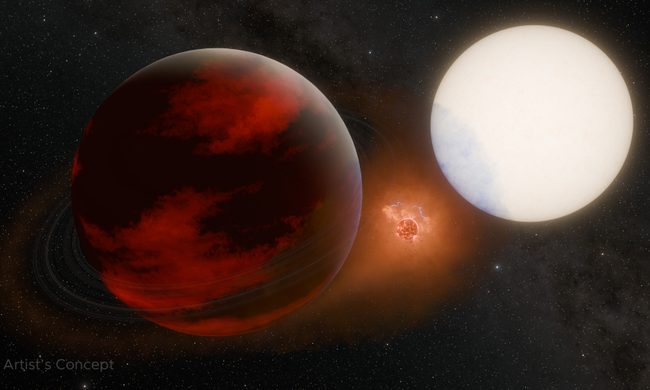
Using the European Southern Observatory’s Very Large Telescope in Chile, researchers detected strong evidence for a moon-like object in the CD-35 2722 system. Further observations are still necessary to confirm the discovery, but it could become the first confidently detected natural satellite outside our solar system. There is still one tiny complication though. This moon is apparently massive.
China’s answer to SpaceX’s reusable rockets literally catches boosters in a net

China just managed to pull off something similar, but in a slightly different way, and on July 10, it tested the method as well.