After Apple announced the long-awaited Apple Watch Series 7, you may have found your eyes, and especially your wallet, drawn to the idea of the Apple Watch Series 3 dropping its price to a downright affordable $199. While it won’t have any of the features of the Series 7, like upgraded specs, improved battery life, a fancy new design, and a plethora of new features, it’ll come in at $200 less, compared to the $399 Series 7. This may sound like a deal on its face. But we advise against falling for this ruse.
First, put this timeline into perspective. Apple released the Series 3 in September 2017. The design back then didn’t put it out of step with other smartwatches on the market. At release, we even praised it in our review as a “joy to use” and the “best smartwatch you can buy.” That was true then, but in 2021 the design has started to show its age.
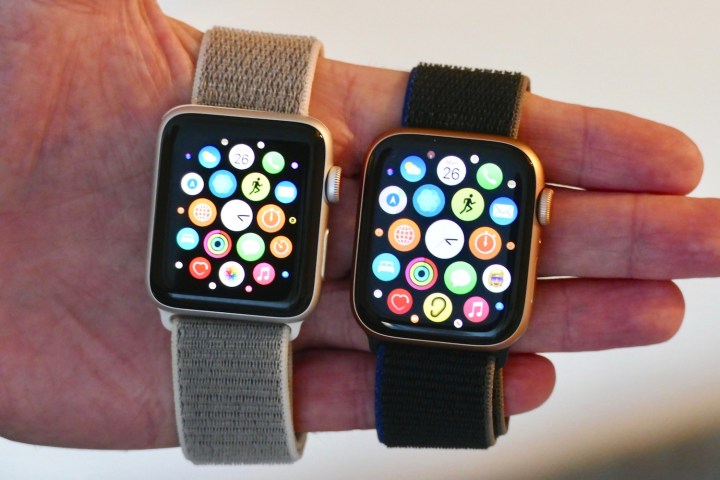
Place the Apple Watch Series 3 next to Series 7 or even an Apple Watch SE and you’ll immediately notice the chunky bezel around the screen and the thicker body. First of all, the Series 3 is only available in Space Gray and Silver Aluminum color options while the latest and greatest Apple Watch Series 7 comes in a slew of different colors giving you better options for style. The Apple Watch Series 3 comes in at 42.5 by 36.4 by 11.4mm and weighs 52.8 grams, compared to the 44 by 38 by 10.4mm and 36.4 grams on the SE. The weight difference is particularly striking, making the Series 3 feel bulky and less comfortable on your wrist.
Like seriously, don't buy the Series 3 (left). Not only have people had trouble updating it to both watchOS 7 and watchOS 8, but there's also no point in living with bezels like that 2021. Not when you look at the Series 6 and 7. Don't do this to yourself. pic.twitter.com/YXk5s2zsJ4
— Victoria Song (@vicmsong) September 14, 2021
Just as the above tweet points out, it’s also pretty clear that you get less screen real estate which impacts how pleasant it is to run apps, keep track of notifications, and use the watch in general. The screen is also a standard Retina OLED rather than the LTPO OLED that you’ll get on newer Apple Watch models, meaning it doesn’t vary refresh rate to preserve battery life.
Forget the Series 7, when Apple released the Apple Watch Series 4 it had a two-fold speed increase over the Watch 3. The Series 7 uses the same processor as the Series 6, but the gap between the two devices is still wide. This doesn’t just impact performance, it also impacts how easily you’ll be able to run WatchOS 8, with reports already coming out about the Series 3 requiring a full wipe before updating to WatchOS 7.4.1, let alone WatchOS 8.
The Apple Watch Series 3 continues to exist in the lineup as a budget alternative to the latest models, but it doesn’t offer enough to fill that role. It’s a heavily compromised device in both design and hardware, and it’s only $79 cheaper than the Apple Watch SE which makes improvements across the board and should still easily support WatchOS 8. From the compass to improved cellular connectivity capabilities to the ECG tracking, you would do yourself a disservice by investing in this “budget” option. In every way, the Apple Watch SE will give you a better experience.
The OnePlus Buds Clip are a new pair of open-ear earbuds built around a simple convenience. They join Sony’s LinkBuds Clip in the growing ear-cuff category, but either OnePlus bud can go on either ear.
Sensors recognize how the earbuds are being worn and route the audio channels accordingly. There’s no label to check before putting them on, and the feature also works when only one bud is used.
We buy fitness bands and activity trackers to keep tabs on our exercise, but it is easy to forget to start tracking or switch modes when moving between different activities. For Fitbit and Pixel Watch users, that could soon become a lot less annoying, as Google is rolling out a major upgrade to automatic activity tracking that can recognize more than 100 types of exercise, up from just 10 before.
Google first showed off the improved tracking earlier this month alongside the Fitbit Edge. It is now coming to Fitbit Air and the Pixel Watch 3, 4, and 5, and Google claims the added context behind the system makes workout detection nearly twice as accurate while cutting missed activities by more than half. Fitbit Edge will support it too.