“Why you can trust Digital Trends – We have a 20-year history of testing, reviewing, and rating products, services and apps to help you make a sound buying decision. Find out more about how we test and score products.“
Although our first mini HD camcorder rodeo roundup crowned Cisco’s Flip UltraHD the reigning king of mini HD camcorders, six months can make a world of difference. Kodak’s new Zi8 bucks the leader by addressing many of its predecessor’s shortcomings, while systematically outdoing the competition on just about every feature. Combined with a reasonable $180 price tag, Kodak’s Zi8 now confidently struts it stuff as king of the ring.
While Flip’s MinoHD and UltraHD still offer a slightly smaller footprint than Kodak’s 2.4-inch by 4.5-inch Zi8, Kodak offers more than enough features to justify the extra bulk. Like the old Zi6, it will shoot 720p HD footage at an extra-fluid 60 frames per second, but also adds full 1080p to the slate for 1920 x 1080 footage at 30 frames per second (not 1440 x 1080 as Sony’s allegedly 1080p Webbie shoots).
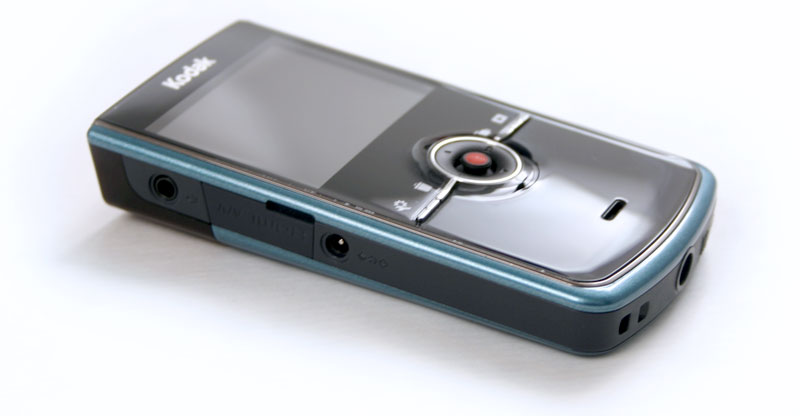
The chunky AA batteries from the Zi6 disappear in favor of a removable lithium-ion unit, but the SHDC slot remains in place of dedicated, built-in memory. Kodak has also added an external microphone input jack for recording better audio, and electronic image stabilization for attempting to eliminate the shakes that come from such a tiny cam. The screen spans 2.5 inches, giving it a leg up on the 2.0-inch screen on the Flip MinoHD.
Like almost all cameras in this category, you’ll find a screen and simple control scheme on the back, which uses four buttons and a standard five-way directional pad. A simple focus slider up top controls the shift from landscape to macro. The Zi8 has both an HDMI jack for outputting high-def video and a more conventional A/V jack for sending out SD content through composite cables. The colorful front door slides off to swap the batteries, while SD cards go in and out through the card slot on the right-hand side above its obligatory fold-out USB plug.
Unlike many competing cams that conveniently charge via USB, you’ll need to charge the Zi8 with an included DC power adapter that plugs into a dedicated jack on the left-hand side. Travelers will find it inconvenient to lug one more brick around to keep it topped off.
Kodak’s relatively generous accessory bundle includes a wrist lanyard, charger with removable cable, and most impressively, both HDMI and composite cables for TV viewing (pretty essential accessories that we can’t believe Flip neglected to include either one of with the second-gen MinoHD). The remote control somewhat deceptively pictured on the box would have made a nice addition for recording, but users who need it can get one for a relatively reasonable $13.
Despite the extra size, Kodak’s Zi8 easily fits most pockets without contributing too much unsightly gadget bulge. It fires up in about a second, but you’ll need to select a shooting mode prior to actually getting rolling. A simple click of the center directional button does the trick, and it remembers whichever mode you were in last time.
Although the controls make sense right out of the box, the center joystick can seem a little finicky before you get used to it. We accidentally recorded a few three second videos before getting used to the pressure needed to make it click sideways instead of down, which initiates recording. Camera mode, review mode, settings and delete all have dedicated buttons beside the directional panel, making the most frequently used options easy to select in a hurry.
Unlike the stiff, switchblade-style USB arms on many competing cameras, which can make it difficult to connect the camera in a crowded row of USB ports, the Zi8 uses flexible rubber arm, which easily bends to accommodate obstructions and feels less fragile. However, we prefer Flip’s ultra-intuitive software to Kodak’s bundled ArcSoft MediaImpression for downloading, organizing and editing clips.
Kodak’s Zi6 took a very close second to Flip’s HD offerings in our mini HD roundup, and the Zi8 proves to be just the boost needed to put it at number one. Shooting in both 1080p and 720p mode, the Zi8 captures colorful, sharp and fluid (especially at 60 fps) video that’s among the best we’ve seen at this price level.
The biggest strike against camcorders in this size class has traditionally been camera shake. Without much mass, these mini HD cams typically jerk around with ease, producing nauseatingly shaky footage in the wrong hands. Kodak has attempted to combat the problem with electronic image stabilization. Although nowhere nearly as effective as optical image stabilization (which no one offers in this size yet), it does help take the edge off the occasional bump or stumble. Even so, it won’t salvage truly bad camerawork the way a $1,200 camcorder will, and wise owners will quickly learn to stand still, pan slowly, and walk with the grace of ballerinas.
We had our pick of the litter when it came to mini HD camcorders to use for shooting our on-the-run coverage of CES 2010, but we walked the halls with Kodak’s Zi8 at the ready. A combination of superior video quality, features and a reasonable price make the Zi8 a clear standout from the competition, even if its looks lag a bit behind some of the super-sleek and customizable cameras from Cisco’s Flip brand.
Related Posts
Your Apple Watch could face a new US import ban over $634m fight

Reuters reports the ITC will examine whether Apple’s redesigned blood oxygen feature still infringes Masimo patents and aims to finish within six months.
Samsung’s Galaxy Buds 4 Pro want you to control audio with your head

Android Authority obtained the animations, which highlight a "Head Gestures" feature that lets the buds respond to simple movements, plus a flatter stem and redesigned charging case.
Your AirPods can act like AirPods again on Android, but there’s a catch

LibrePods is a free app by developer Kavish Devar that, according to its project page, brings "full AirPods functionality" to Android and Linux.